
Quick answer for commercial buyers
Peeling, cracking and rubber-to-metal separation are not one defect with one cause. A lifted edge may point to contamination or an incomplete bond; a crack can begin at a sharp core transition, thin section, trim cut or impact point; a dusty film may be surface bloom rather than separation. The buyer should define each condition with photographs, locations and an acceptance action before approving a bulk order.
Start with the exact dumbbell or plate construction, not the word rubber. Record the core, elastomer family, preparation, bonding system, molding route, finish, cleaning exposure, storage and intended handling. For OEM, ODM, custom-logo, private-label or bulk supply, approve representative finished samples and link the test evidence to the same material, geometry and process revision.
Peeling, cracking, bloom and molding marks are different
Peeling or delamination means the covering is separating from the substrate or from another layer. Cracking is a split in the elastomer and may occur without bond loss. A parting line, trimmed gate or shallow flow mark can be a manufacturing appearance feature when it stays within an approved cosmetic limit. Bloom is material that migrates to the surface and may appear as a film; tackiness, staining and color transfer are separate observations that need their own definitions.
Do not let an inspector classify every line as a structural failure, but do not dismiss a lifted edge as cosmetic. Mark zones on the drawing: handle transition, head corners, logo recess, plate rim, grip opening, insert boundary and flat faces. State which findings trigger quarantine, which allow documented rework and which are compared with the approved sample.
Map the coating process before writing a test
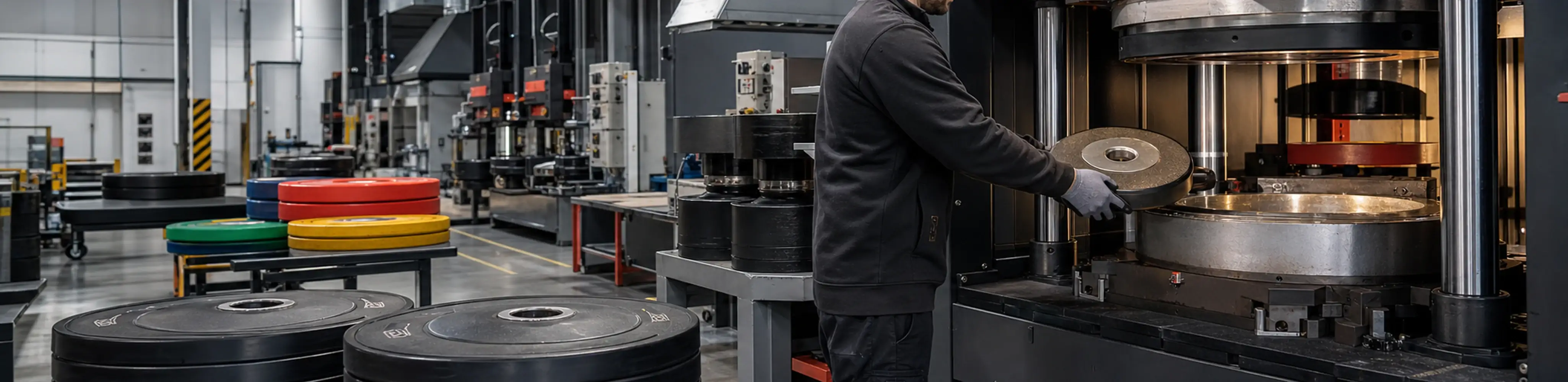
A bonded rubber covering depends on the complete route: core material and geometry, removal of oil or scale, surface preparation, primer or bonding system where used, compound identification, molding conditions, cure, cooling, demolding and trim. The exact route varies between vulcanized rubber, thermoplastic elastomers, cast polyurethane and other constructions, so a buyer should not prescribe an unfamiliar chemistry from a catalogue description.
Ask the factory which steps are critical for the offered model and how they are controlled. A clean sample can still be unrepresentative if it used a different core finish or hand-prepared surface. Conversely, one production mark does not prove weak adhesion. The useful record connects material lot, core revision, process route and finished inspection to the SKU.
Locate where the defect begins
Edges and transitions concentrate handling and impact. On a hex dumbbell, inspect every corner, the junction around the handle and any recessed lettering. On a round dumbbell, check the circumference, end face and rack contact zone. On a coated plate, examine the rim, grip openings, center insert, lettering, seam and any place where the cover becomes thin. Compare both sides and more than one weight because core size and coating thickness can change through a range.
Record whether failure begins within the rubber, at the rubber-to-core interface, at a printed mark or at an attached badge. That observation directs the corrective question. Surface tearing, adhesive-interface separation, loose inserts and print wear are different paths. A close photograph should include the SKU and scale reference; it cannot replace a defined examination or measurement.
Use laboratory methods within their real scope
ISO 813 and ASTM D429 describe methods for assessing rubber adhesion to rigid substrates using prepared specimens and defined fixtures. They can support compound, bonding-system and process comparisons when an applicable specimen can be made. They do not supply a universal peel value for every finished dumbbell or plate, and their specimen geometry may not represent a curved head, grip opening or fully molded core.
ISO 4649 compares abrasion resistance under a rotating-drum method and warns against inferring a close relationship with service behavior. ASTM D1149 evaluates ozone cracking under controlled accelerated conditions and likewise limits what can be inferred about real use. If one of these methods is relevant, specify edition, specimen, conditioning, equipment, result expression and pass rule. Keep material evidence separate from finished-product handling or impact validation.
Coating defect and evidence matrix
| Observation | Question to resolve | Useful evidence |
|---|---|---|
| Lifted edge | Is the covering separating from the core? | Location photo, sample comparison and bond review |
| Crack | Is the split superficial or progressing through the cover? | Marked zone, depth description and disposition rule |
| Surface film | Is it bloom, residue, contamination or transfer? | Cleaning method, material review and retained sample |
| Seam or trim line | Is it within the approved appearance limit? | Drawing zone and controlled-light reference |
| Insert boundary | Are coating, insert and core still secure? | Fit, movement and post-check record |
| Laboratory adhesion | Does the specimen and method match the decision? | Standard edition, specimen, conditioning and result |
| Abrasion or aging | Is the result comparative or a service-life claim? | Method, exposure and limited conclusion |
| Production lot | Does the shipment match the approved revision? | Sampling plan, findings and change history |
Approve samples that represent the difficult variants
A single middle-weight sample may hide the hardest geometry. Select light, middle and heavy SKUs, plus any weight where core shape, head size, plate thickness, insert, color or logo process changes. Approve surface texture, seam, trim, color, hardness reference if used, bond-edge condition, weight marking, odor evaluation method, packaging and cleaning instructions under one sample record.
The approval should identify which observations are visual and which come from a controlled test. Keep photographs under consistent lighting, actual measurements, the sample code and the artwork revision. If the factory supplies a display sample made by a different route, label its limits. Production release should wait for a representative construction or an explicitly agreed validation plan.
Separate design validation from lot inspection
Design validation asks whether the chosen core, covering and bond system can meet the intended use. Lot inspection asks whether shipped products match that approved design. Routine receiving can verify identity, weight, dimensions, appearance, lifted edges, cracks, trim, insert boundary, logo, surface transfer, quantity and packing. It cannot recreate every destructive or accelerated laboratory test on saleable pieces.
Build a risk-based sampling plan across cartons, production times and weight variants. Define how inspectors probe a suspicious edge without creating a new defect, how the condition is photographed, and who decides disposition. If rework involves grinding, rebonding, paint or heat, the affected checks must be repeated. Average results must not hide an individual product that meets a quarantine rule.
Control OEM color, logo and material changes
A molded custom logo can change local thickness, flow and demolding around letters. Paint fill or printing adds a new surface-preparation and wear question. A new color can require a compound or pigment change, while a private-label badge introduces its own attachment interface. Treat these as controlled product revisions rather than decorations added after quality approval.
For ODM changes, review sharp corners, recess depth, release angle, core texture and areas where rubber becomes thin. For repeat orders, require notice before a compound, core supplier, preparation chemical, adhesive, mold, cure route, logo process or packaging contact material changes. ChinaFreeWeight can review model-specific feasibility as a factory, but availability, minimums and timing are confirmed only after the product range and customization are defined.
Packaging and gym use can create misleading damage
Heavy products rub and press against each other in transit. A carton without restraints can create polished contact patches, edge cuts, color transfer or compressed areas that resemble production inconsistency. Approve separators, orientation, carton loading and pallet restraint with the product. Do not trap a surface against an incompatible film, ink, adhesive or foam without checking contact behavior.
At receiving, photograph packaging before cleaning the product. Use only approved cleaning agents and allow the surface to dry. In service, follow the maker's handling, storage and inspection guidance; remove products with progressive separation, deep cracks, loose structural parts or an unresolved condition. A maintenance team should not field-repair a bonded coating and assume the original product evidence still applies.
Send suppliers one comparable coating brief
List product family, weights, core construction, elastomer or covering declaration, intended facility, handling, flooring, climate, cleaning products, colors, logo, quantities, packing and destination. Ask for the proposed process, critical controls, representative samples, change-notification rule, finished-product inspection and any material or adhesion evidence relevant to the exact construction.
Separate mandatory acceptance criteria from questions the supplier must resolve. Do not insert an arbitrary peel force, drop height, cycle count or hardness value copied from another model. A useful quotation states what is included, which variants share construction, where tooling changes and what evidence will be available before mass-production release.

Ten-point coating approval checklist
- Identify the exact core and covering construction.
- Map edges, corners, inserts, grip openings and thin zones.
- Define peeling, cracking, bloom, tack and cosmetic marks separately.
- Approve light, middle, heavy and change-point variants.
- Record process and material revision with the sample.
- Match each test method to a stated decision and specimen.
- Set visual, dimensional and quarantine criteria before production.
- Control color, logo, compound, mold and packaging changes.
- Sample across cartons, production periods and SKUs.
- Retain evidence for claims, rework, shipment and reorders.
Products and related buyer guides
- Review rubber hex dumbbells
- Browse commercial dumbbells
- Browse weight plates
- Compare rubber, PU and TPU dumbbells
- Compare plate materials
- Plan OEM sample approval
- Prepare pre-shipment inspection
- Discuss a coating specification
Frequently Asked Questions
Why does rubber coating peel off a dumbbell?
Possible causes include contamination, unsuitable preparation or bonding, geometry, molding variation, damage or aging. The exact cause requires examination of the location, failure surface and process history.
Is every seam or line a delamination defect?
No. A controlled parting or trim line can be cosmetic, while a lifted edge or growing separation needs a different action. Define examples during sample approval.
Can ISO 813 provide a pass value for a finished dumbbell?
The method evaluates prepared rubber-to-rigid-substrate specimens. It does not choose a universal finished-product limit; applicability, specimen and acceptance must be agreed.
Should every item receive a peel test?
Destructive adhesion methods are not routine checks for every saleable item. Use design or process evidence plus a lot inspection plan suited to risk.
Do custom logos affect coating quality?
They can change local thickness, flow, demolding, paint adhesion or attachment. Approve the branded construction, not an unbranded substitute.
Which weights should be sampled?
Choose light, middle and heavy sizes plus every point where core geometry, covering, color, insert or logo process changes.
What should buyers do with cracked or separating products?
Quarantine them, preserve evidence and follow the agreed supplier or facility decision process. Do not improvise a repair and return them to use without responsible review.

Specify a rubber-coated free weight order
Send the product range, construction, use, colors, logo, quantities, packing and acceptance needs for a model-by-model factory review. Request a quotation.