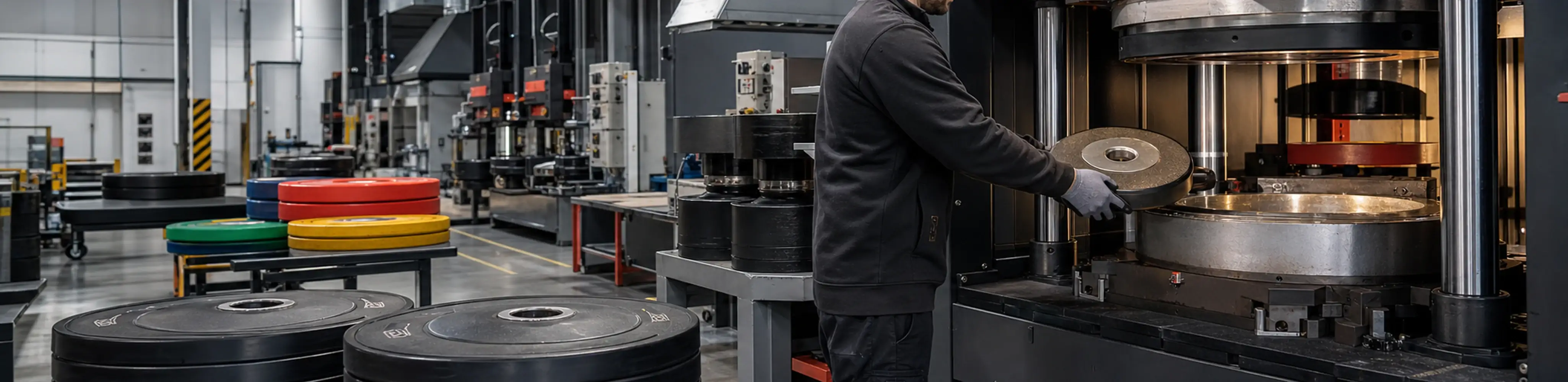
Bumper plates are made by forming a resilient rubber or polymer body around a metal center insert, then curing, finishing, weighing, and inspecting the plate. In a common rubber process, the manufacturer prepares a controlled compound, cuts or preforms the material, positions the insert in a heated mold, and applies pressure and temperature so the plate takes its final shape and the rubber vulcanizes. After demolding, operators remove flash, apply markings or branding, check dimensions and weight, and test the insert, surface, and bounce behavior.
The exact route depends on the product. Solid virgin-rubber training plates, crumb-rubber economy plates, competition-style plates, and cast polyurethane or CPU plates use different formulations, molds, cycle conditions, and finishing methods. This guide explains the production stages that importers, gym owners, distributors, and private-label brands should understand before comparing samples or quotations. It separates general manufacturing facts from buyer recommendations; specific compounds, cycle parameters, and tolerances remain part of each factory's controlled specification.
Quick Answer: How Are Bumper Plates Made?
Question: How are bumper plates made?
Answer: Most rubber bumper plates are produced by preparing a measured rubber compound, placing it with a steel or stainless center insert in a heated compression mold, and applying pressure while the material cures. The plate is then cooled, demolded, trimmed, marked, weighed, and inspected for diameter, thickness, insert fit, surface quality, and consistency. Crumb-rubber, solid-rubber, competition, and cast-polyurethane plates require different materials and process controls, so buyers should approve a written specification and production sample.
What Are Bumper Plates?
Bumper plates are full-diameter weight plates designed for barbell training in which the loaded bar may be dropped onto suitable lifting platforms. Their resilient body reduces floor and equipment impact compared with bare iron or steel plates. Olympic-style bumper plates use a metal center opening that fits the bar sleeve; the exact dimensions and tolerances depend on the target standard and product grade.
They are common in Olympic weightlifting, functional training, strength and conditioning, school facilities, and commercial gyms. “Bumper plate” describes function, not one material recipe. Two black plates may differ in density, hardness, odor, bounce, insert construction, weight accuracy, and expected service life.
Are bumper plates made entirely of rubber?
Usually not. The main body may be rubber or a cast polymer, but the center contains a metal insert or hub that interfaces with the bar sleeve. Competition-style plates can have a larger metal hub assembly, while economy training plates often use a smaller ring insert. Some plates also use internal metal mass or engineered structures to reach target weight and thickness. Construction should be confirmed from the supplier rather than inferred from the exterior.
What is the difference between bumper plates and weight plates?
All bumper plates are weight plates, but not all weight plates are bumpers. Conventional iron, steel, or grip plates may be intended for controlled loading and should not be dropped. Bumper plates use a resilient full-diameter body designed for lifting platforms. Buyers choosing between the two can use the weight plates versus bumper plates guide and compare the complete weight plate range.
Which Materials Are Used to Make Bumper Plates?
Manufacturers select material according to target price, hardness, rebound, appearance, odor, abrasion resistance, color, and processing route. The formulation—not just the broad material name—determines performance.
| Plate type | Typical body material | Common characteristics | Buyer questions |
|---|---|---|---|
| Solid rubber training plate | Natural/synthetic rubber blend with fillers and additives | Dense, relatively thin, clean molded surface | Compound control, odor, hardness, weight consistency |
| Crumb-rubber plate | Recycled rubber granules with binder | Thicker profile, visible granules, often lower rebound sharpness | Granule size, binder, shedding, insert security |
| Competition-style rubber plate | Higher-spec controlled rubber with large hub | Precise appearance, color coding, tighter target specification | Hub fit, calibration plan, dimensions, approval standard |
| CPU or cast polymer plate | Cast polyurethane system | Fine surface detail, color and branding options | Casting process, hardness, hydrolysis/UV expectations, cure control |
Are bumper plates made from recycled tires?
Some crumb-rubber bumper plates use recycled tire rubber that has been cleaned and processed into granules. Other bumper plates use solid rubber compounds based on virgin or controlled blended materials. “Recycled” does not automatically mean poor quality, and “virgin rubber” does not guarantee a good plate. Granule consistency, contamination control, binder ratio, molding, density, insert design, and inspection determine the finished result.
What rubber is used in bumper plates?
Factories may use natural rubber, styrene-butadiene rubber, or other elastomers blended with carbon black or pigments, process aids, curing agents, fillers, and protective additives. The formula is selected to balance tensile behavior, tear resistance, hardness, rebound, appearance, cost, odor, and mold flow. Exact recipes are normally proprietary. Buyers should focus on measurable product requirements and approved-sample consistency rather than demanding a generic “100% rubber” claim that does not define performance.
How is the rubber compound prepared?
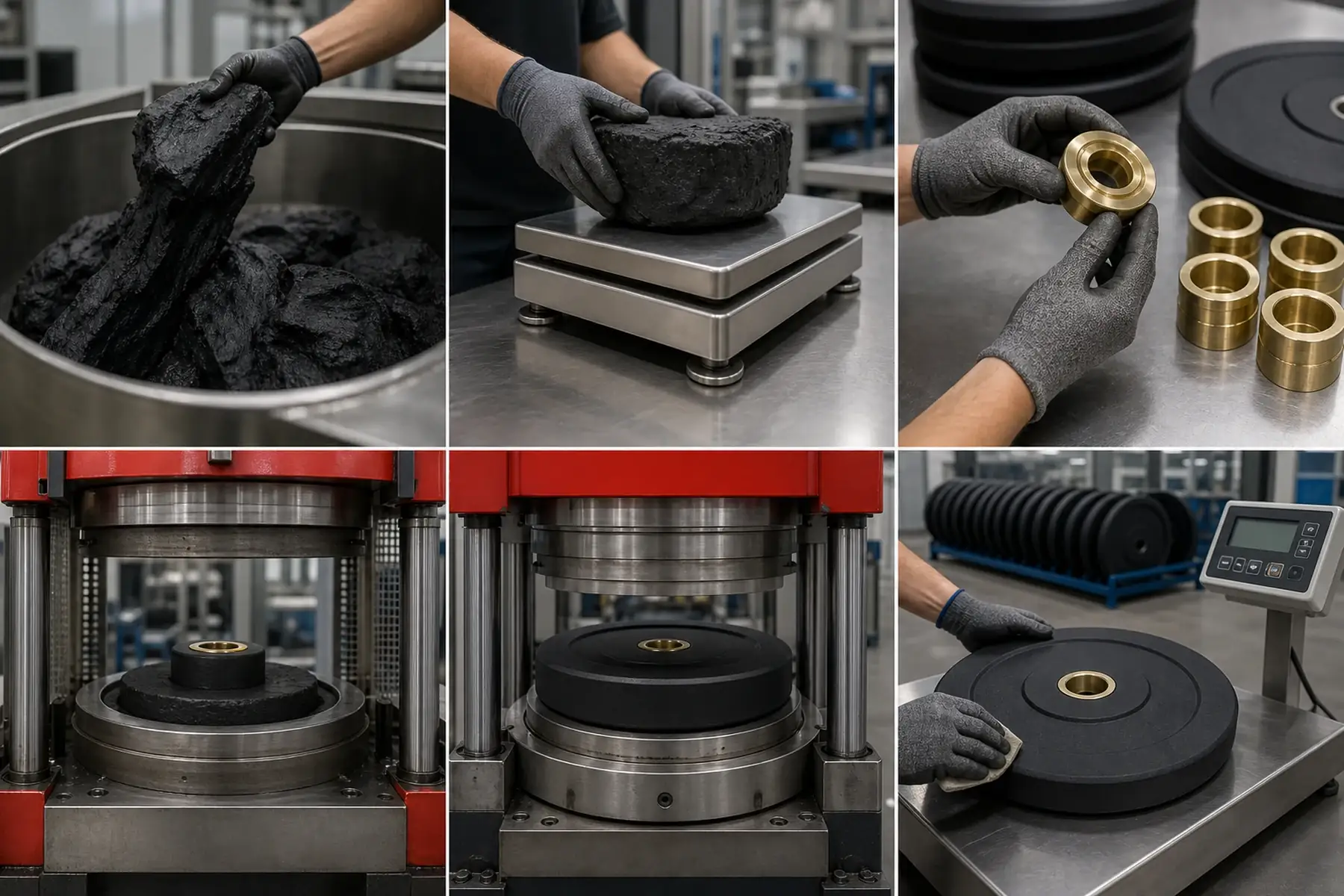
For solid molded plates, raw elastomers and additives are weighed to a controlled recipe and mixed until the ingredients are evenly dispersed. Industrial mixing creates heat and shear, so time and temperature must be managed. The compound may then be sheeted, cooled, rested, and cut into preforms sized for the mold cavity.
Variation at this stage can cause color streaks, inconsistent hardness, voids, odor differences, poor curing, and weight problems. Material identification and batch records help the factory trace a finished plate back to its compound lot.
How are crumb-rubber preforms prepared?
Crumb plates typically start with rubber granules graded by size. The granules are mixed with a binder and sometimes pigment, then weighed for each mold. Even distribution matters: too little binder can increase shedding, while too much can alter feel, cost, and cure behavior. The prepared mixture is placed around the center insert and compressed into the cavity. This is a different production route from vulcanizing a dense sheet-rubber preform.
How are the center inserts manufactured and installed?
The insert is the interface between the plate and bar sleeve. It may be stainless steel or another treated metal, stamped, formed, cast, or machined to the product design. Edges, concentricity, inner diameter, surface finish, and anti-rotation features affect assembly and use.
Before molding, the insert is cleaned and may receive a surface treatment or bonding system. The mold fixture must locate it concentrically. If it shifts during molding, the hole may be off-center, producing uneven rotation and inconsistent loading on the bar. Insert design must also resist loosening under repeated drops.
Why do bumper plate inserts come loose?
Loose inserts can result from poor bonding, contamination, inadequate mechanical locking, incorrect molding conditions, an off-center insert, or repeated use beyond the product's intended environment. Dropping light plates alone can create high deformation at the hub because the plate is thin. Buyers should ask how the insert is retained and what inspection or durability test is used. Visual appearance alone cannot confirm long-term security.
How Does Compression Molding Form a Bumper Plate?
Compression molding uses a matched metal mold mounted in a heated press. The operator or automated system places the weighed rubber preform and centered insert into the cavity. The press closes and applies pressure. Heat and pressure make the compound flow through the cavity and start the curing reaction that gives rubber its stable elastic properties.
Mold temperature, pressure, cure time, preform weight, material temperature, and venting must work together. Too little material may cause short fills or low weight. Too much creates excessive flash. Under-curing can weaken properties; over-curing can reduce performance or change color. After the specified cycle, the press opens and the plate is removed carefully.
What is vulcanization in bumper plate manufacturing?
Vulcanization is the chemical curing process that forms cross-links within the rubber. It turns a soft, processable compound into a resilient finished material. Heat accelerates the reaction, while the formulation determines how the cure proceeds. A manufacturer controls time and temperature so the plate reaches the intended physical properties without scorching before molding or remaining under-cured after demolding.
What happens after the plate leaves the mold?
The hot plate is placed on a controlled surface or fixture to cool without warping. Operators trim flash and inspect the edge, faces, lettering, and insert. Depending on the design, markings may be molded into the plate, filled with color, printed, bonded, or applied as separate elements. Competition-style hub components may require additional assembly and fastening.
The plate is then conditioned before final weight and dimensional checks. Testing too early—while temperature or material condition is unstable—can create misleading readings. Packaging should also wait until the product has completed the required cooling and airing period.
Typical post-molding checklist:
- Plate lies flat without visible distortion.
- Center insert is clean, secure, and concentric.
- Edge flash is removed without gouging the body.
- Molded letters and logo are complete.
- Color and surface match the approved sample range.
- Plate weight and key dimensions meet the purchase specification.
- Packaging surfaces are dry, clean, and protected.
How Are Bumper Plates Weighed and Calibrated?
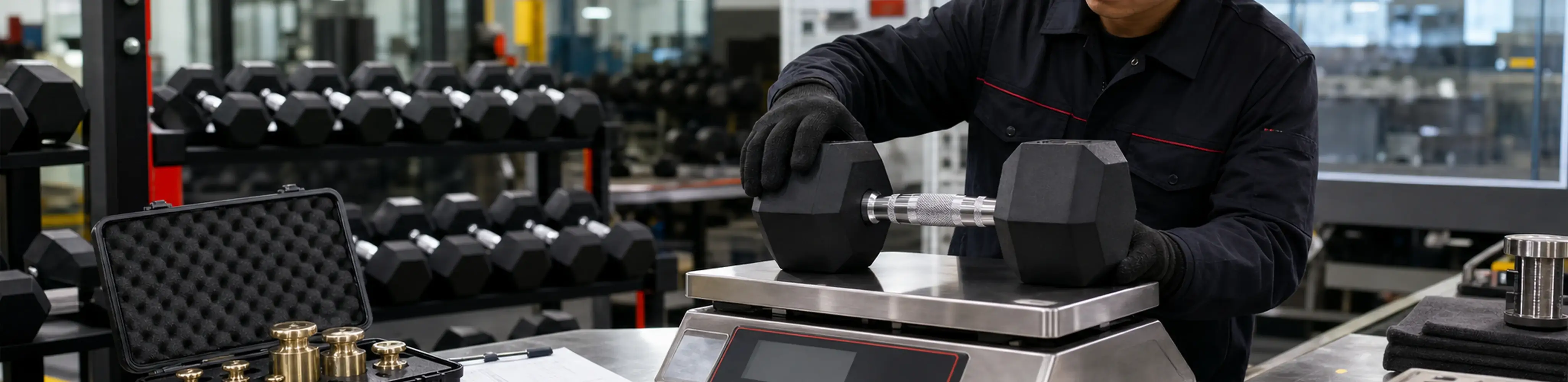
Each product specification should define the nominal weight and acceptable tolerance. The factory verifies scale performance with suitable reference weights, weighs plates under consistent conditions, records results, and separates nonconforming units. Some production routes allow small corrections before final sealing or assembly; others require rejection or rework.
Competition-style plates may target governing-body equipment requirements, while general training plates follow the manufacturer's declared commercial tolerance. A buyer should not assume that the word “Olympic” means competition-calibrated. “Olympic” is often used in the market to describe the sleeve format and plate style.
How accurate are bumper plates?
Accuracy varies by grade, weight, material, and supplier specification. Calibrated competition plates generally target tighter control than economy training bumpers. The buyer should ask for the numerical tolerance, weighing method, sampling plan, and treatment of out-of-range pieces. A vague claim such as “accurate weight” is not a measurable acceptance criterion. The article on how dumbbells are weighed explains the same metrology principles in more detail.
Why are lighter bumper plates often thicker than expected?
Plate thickness depends on material density and the amount of body structure required for durability. Low-weight plates must still reach the standard full diameter, so a low-density crumb compound may produce a relatively thick profile. Dense competition plates can be thinner, leaving more loading space on the sleeve. Thin low-weight plates may also deform more when dropped alone, so design must balance width, stiffness, and durability.
What Quality Tests Are Used for Bumper Plates?
Quality control combines incoming-material checks, in-process observations, and finished-product inspection. No single drop count proves every aspect of quality. A useful plan checks the characteristics that matter for the intended gym environment.
| Inspection point | Method | Quality purpose |
|---|---|---|
| Weight | Verified scale and documented tolerance | Correct loading and set consistency |
| Diameter and thickness | Caliper, gauge, or fixture | Rack, platform, and sleeve planning |
| Center hole and concentricity | Gauge and rotation/fixture check | Smooth loading and balanced behavior |
| Insert retention | Defined pull, torque, or durability method | Reduce loosening risk |
| Hardness | Durometer on conditioned material | Monitor compound and bounce consistency |
| Surface and markings | Visual standard under controlled light | Consistent appearance and legibility |
| Drop durability | Defined bar, load, height, platform, and cycle | Evaluate product-system performance |
| Packaging | Carton, protection, label, and pallet review | Reduce export damage and sorting errors |
How is bumper plate bounce tested?
Factories may compare rebound using a controlled drop height, surface, plate weight, bar setup, and recording method. The procedure must be consistent; dropping by hand on different floors is only a rough demonstration. Very low bounce is not automatically best if the compound becomes harsh or brittle, and high bounce can make a loaded bar difficult to control. The target should match training use and the approved sample.
Do bumper plates need a drop test?
For products intended to be dropped, a defined durability test is valuable. The test should state which plate weights are loaded, whether plates are dropped alone or as a pair on a bar, the platform, drop height, cycle count, and failure criteria. This matters because a thin light plate dropped alone experiences different stress from a full training load. Buyers should compare test definitions, not only impressive cycle-count claims.
What Manufacturing Problems Cause Poor Bumper Plates?
Common defects include weight variation, off-center inserts, insert movement, incomplete fills, excessive flash, surface contamination, color variation, warping, odor complaints, cracking, and weak markings. Causes may trace back to materials, mold condition, preform weight, centering, cure control, cooling, trimming, or storage.
Factory corrective workflow:
- Identify and quarantine the affected lot.
- Confirm the defect against the approved standard.
- Trace material batch, mold, press, shift, and process record.
- Correct the source rather than only sorting finished plates.
- Revalidate the process with new samples.
- Document disposition of rejected or reworked units.
How Should Buyers Choose a Bumper Plate Manufacturer?
A reliable manufacturer should turn application requirements into a controlled product specification. Buyers need evidence that the factory understands material, molding, insert, weight, appearance, and packaging as connected processes.
Expert supplier-evaluation checklist:
- Compare physical samples from the intended production route.
- State plate type, weight range, units, colors, diameter, thickness targets, and tolerance.
- Confirm insert material, construction, fit, and retention method.
- Agree on hardness or bounce expectations using a defined comparison.
- Approve logo artwork, marking method, and color standard.
- Review in-process and pre-shipment inspection records.
- Test cartons and pallets for the heavy-product shipping route.
- Confirm repeat-order material and color controls.
PowerBaseFit works with rubber and CPU plate categories, OEM logos, color and marking programs, weight checks, surface inspection, packaging, and export preparation. Buyers can compare the rubber bumper plate, CPU bumper plate, color CPU bumper plate, and rubber competition bumper plate, then review our factory capabilities.
What should be included in a bumper plate RFQ?
Include the product grade, KG or LB weight range, quantity per size, target diameter and hole format, tolerance, material preference, color code, logo files, marking process, packaging, inspection requirement, destination country, and timeline. State whether the plates are for training, commercial functional fitness, school use, or competition preparation. A detailed RFQ lets the manufacturer quote the correct construction instead of assuming the lowest-cost option.
Frequently Asked Questions About Bumper Plate Manufacturing
How long does it take to mold one bumper plate?
Cycle time varies with material, thickness, weight, mold design, press capacity, and cure system. A thick or dense plate can require a different heating and cooling profile from a light crumb plate. Quoting one universal number would be misleading. For lead-time planning, buyers should ask about mold count, daily production plan, color changes, logo tooling, sample approval, conditioning, inspection, and packaging—not only the press cycle.
Are colored bumper plates made from colored rubber?
Many solid-color plates use pigments dispersed through the body compound, while others use colored outer layers, inserts, or marking elements. Color-through construction can hide scratches better than a very thin surface application, but pigment and formulation can affect processing. Confirm the cross-section design and approve a physical color range. Digital screen colors are not reliable production standards by themselves.
What makes competition bumper plates more expensive?
Competition-style plates usually involve tighter dimensional and weight control, higher-spec materials, large precision hubs, more complex assembly, controlled color presentation, and additional inspection. Tooling and lower acceptable defect rates also affect cost. A plate that only copies the visual style may not meet a federation's current equipment requirements. Buyers requiring certified or licensed equipment should verify the exact governing-body status separately.
Can bumper plates be made in custom colors?
Yes, depending on material, order size, pigment feasibility, and tooling. Custom colors require an agreed physical reference and an acceptable variation range because rubber and polymer batches are not identical to backlit screens. Buyers should also decide whether standard weight-color conventions matter for their market. A unique brand palette may look strong in a retail range but confuse lifters in a performance facility if markings are unclear.
Why do some bumper plates crack?
Cracking can result from a brittle or poorly cured compound, contamination, thin-section stress, repeated dropping on unsuitable surfaces, cold conditions, aging, or damage around the insert. Light plates dropped alone often experience severe flexing. A complete investigation considers product construction and use conditions. Gyms should use appropriate platforms, keep plates away from sharp edges and chemicals, and remove damaged units from service.
Can a factory make both KG and LB bumper plates?
Yes. The mold, core weight, markings, color program, and packaging must match the selected unit system. Dual-marked products are also possible, but the nominal conversion and displayed values should be decided clearly. Importers should confirm whether local customers expect kilogram competition colors, pound increments, or both. Cartons and inventory codes must follow the same unit logic to avoid shipment errors.
Are CPU plates the same as rubber bumper plates?
No. CPU commonly refers to a cast polyurethane process, while traditional bumpers use vulcanized rubber or crumb rubber with binder. Both can be designed for barbell training, but their chemistry, molding route, surface feel, color, abrasion behavior, and cost differ. Ask the supplier for construction details and approved use rather than treating CPU as simply “premium rubber.”
How should bumper plates be packaged for export?
Heavy plates need cartons sized for safe handling, abrasion protection between faces, reinforced seams, clear weight labels, and a stable pallet pattern. Hub surfaces should not rub directly against neighboring plates. The pallet must suit the shipment route and destination handling. Buyers should approve carton artwork, piece count, net and gross weight, pallet protection, and loading photos where required.
Standards, Sources, and Production Inquiry
Competition-focused buyers should review the current International Weightlifting Federation technical rules for applicable equipment requirements. General training plates should follow a clear buyer-and-manufacturer specification rather than borrowing a certification claim.
Send PowerBaseFit the plate style, full weight mix, quantities, unit system, logo, colors, tolerance expectation, packaging, and destination. We can review production feasibility, sample requirements, quality checkpoints, and an OEM quotation.
Request a Bumper Plate Manufacturing Quote