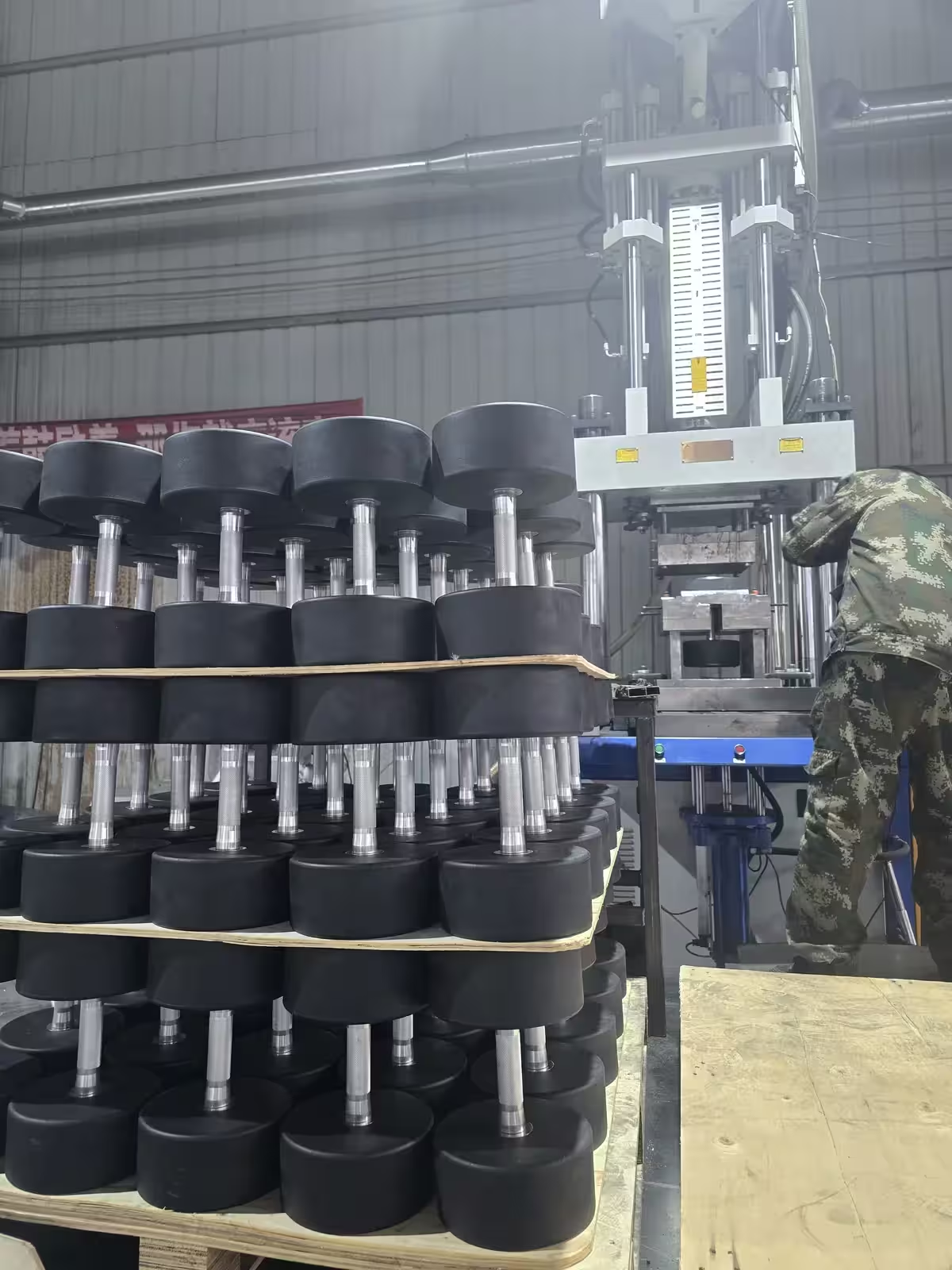
Introduction
An OEM sample is useful only when the buyer and manufacturer agree what it proves. A dumbbell can have the correct logo but the wrong handle, an acceptable color but an unapproved weight marking, or a strong carton that does not match retail artwork. Saying “sample approved” without a controlled record leaves room for both parties to remember the decision differently.
A disciplined approval process turns the sample into a production reference. It links the physical unit to model, materials, dimensions, measured weight, finish, branding, labels, packaging, revision, date, and authorized exceptions. The process is especially important for private-label ranges, where appearance must remain consistent across weights and repeat orders.
Quick Answer
Define the purpose of the sample before it is made. Issue a controlled specification and artwork pack, then decide whether the first unit is a standard construction sample, logo sample, color sample, packaging mock-up, or complete pre-production sample. On receipt, verify identity, construction, measurements, weight, finish, markings, logo, assembly, use-related fit, and packaging.
Record actual results and deviations. Approve, approve with written conditions, or reject. Assign a revision and retain matching references with buyer and factory. Any later change to material, dimension, color, logo, packaging, or process must be reviewed rather than silently incorporated into production.
Definition: Standard, Custom, and Golden Samples
A standard sample demonstrates an existing model and may help the buyer assess shape, handling, construction, and general finish. It does not prove custom color, logo, markings, or packaging. A custom sample adds selected brand elements. A pre-production sample aims to represent the complete approved configuration before the main run.
The term “golden sample” is often used for the signed physical reference retained for comparison. It should not stand alone. Materials can age, colors can shift under lighting, and dimensions are difficult to judge visually. The golden sample must be supported by drawings, measured data, artwork, material descriptions, and acceptance criteria.
Write a Sample Brief Before Production
The brief should identify product, model, nominal weight, measurement unit, intended market, purpose, and decisions to be approved. List core material, coating or compound, handle or insert construction, color reference, logo method, logo position, weight marking, labels, barcode, carton, and protection.
Separate mandatory requirements from factory recommendations. If the buyer is comparing two logo methods, request two clearly labeled samples or panels. If only color is under review, do not let the sample become an implied approval of an unfinished carton.
Include a target date and shipping method, but allow time for tooling, curing, finishing, and packing. Custom samples may not follow the same economics or cycle as a production lot, so the factory should state which steps are representative and which are sample-only.
Control Artwork and Revisions
Use vector artwork where possible and assign filenames and revision codes. State logo dimensions, position references, orientation, colors, weight-unit format, font or approved outlines, and any required legal or commercial labels. Avoid approving artwork from a compressed chat image.
The manufacturer should return a placement proof for approval before making tooling or applying the mark. Check every language, number, unit, and trademark detail. For ranges with many molds, confirm whether the logo scales or changes position by weight.
When artwork changes, issue a new revision and close the previous one. The production order should reference only the active files. This prevents an older logo or label from reappearing during replenishment.
Inspect Construction and Measurements
Confirm that the sample is the quoted construction. For dumbbells, review head shape and core, coating, head-to-handle connection, handle material, grip length, diameter, knurling, and overall length. For plates, review body material, insert or hub, center opening, diameter, thickness, grip holes, and edge profile.
Measure characteristics that affect use, rack compatibility, packaging, or brand appearance. Record actual values and tools used. Compare them with drawing tolerances or agreed ranges. Do not replace a missing specification by measuring one sample and assuming the result is automatically the production limit.
If the buyer requires drop, hardness, torque, load, odor, chemical, or laboratory evidence, define the method and responsible party. A one-time informal demonstration cannot establish a repeatable acceptance rule.
Verify Weight and Range Consistency
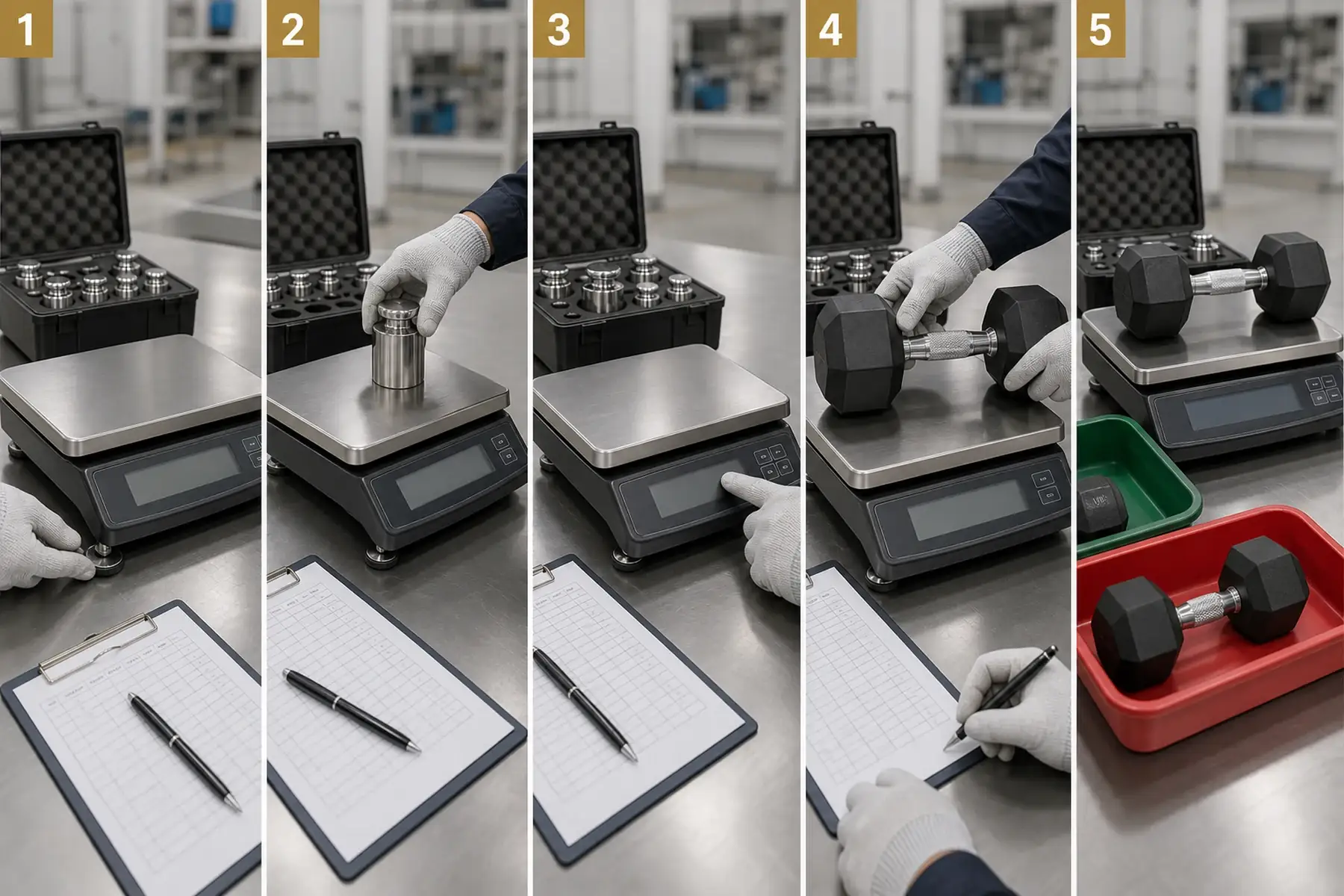
Use an appropriate scale and record the sample's measured weight. The permitted tolerance must be agreed for the model and market. A sample can be visually excellent and still fail the commercial specification if weight is outside the approved limit.
One sample weight does not prove the complete range. Ask the factory how construction, dimensions, mold, inserts, and markings change across light and heavy products. For a new private-label range, consider reviewing representative low, middle, and high weights or approving a production pilot that covers multiple sizes.
Check how nominal weight appears on product, carton, barcode, and commercial documents. Kilogram and pound conversions should follow the buyer's approved convention rather than an unreviewed automatic calculation.
Review Finish, Color, Logo, and Markings
Inspect under consistent lighting. Compare coating coverage, texture, sheen, seams, flash, edges, cleanliness, and defined cosmetic limits. A handmade custom sample may include process evidence that differs slightly from full production, so the factory must explain what will improve or remain the same.
Use a controlled color reference when color is commercially important. Screens and photographs are not reliable color standards. Agree whether comparison uses a physical chip, sample panel, instrument value, or visual range. Record the viewing condition.
Check logo spelling, proportions, orientation, size, position, contrast, adhesion or molding, and relation to weight markings. Test reasonable handling appropriate to the process. Do not invent a durability test after receiving the sample; agree it before manufacture.
Approve Packaging as a System
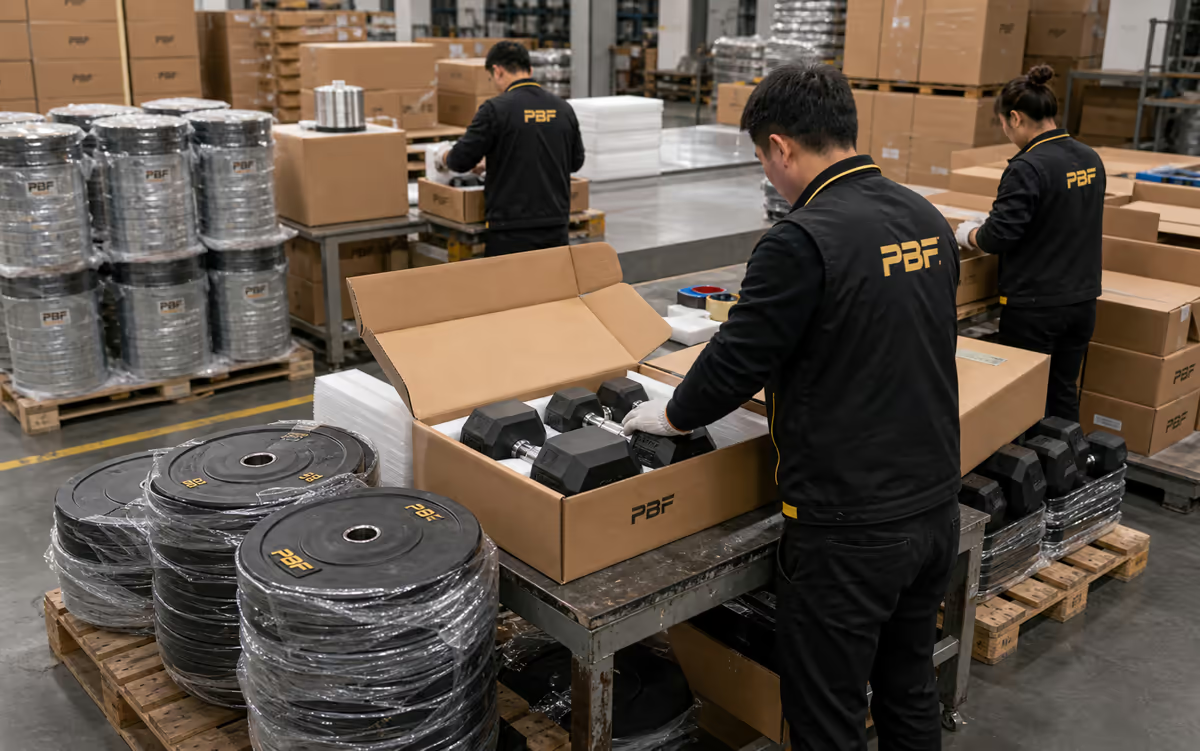
The product sample and packaging sample should be evaluated together when the final pack affects fit or protection. Confirm bag, separator, foam, carton strength, internal movement, retail presentation, barcode, labels, manuals where applicable, carton quantity, gross weight, and shipping marks.
Heavy free weights can damage their cartons or nearby products. Shake or handling evaluations need a defined method; transit testing should use the relevant standard and configuration when required. A decorative box is not approved if it cannot contain the actual product safely.
Check that the artwork matches the correct SKU and nominal weight. For a range, a packaging matrix may be more useful than producing every printed carton as a sample. Approve shared elements and then verify weight-specific data during pilot production.
Use a Formal Approval Table
| Decision area | Evidence | Approval status |
|---|---|---|
| Product identity | Model, SKU, nominal weight, photographs | Approved / revise |
| Construction | Material, handle or insert, assembly | Approved / revise |
| Measurements | Drawing and recorded values | Approved / revise |
| Weight | Scale reading and agreed tolerance | Approved / revise |
| Appearance | Finish, color, cosmetic boundary | Approved / revise |
| Branding | Artwork revision, logo, markings | Approved / revise |
| Packaging | Pack components, label, barcode, carton | Approved / revise |
| Open items | Owner, action, deadline | Closed / pending |
Approval should include the buyer representative, factory representative, date, revision, sample ID, and conditions. “Approved with comments” is risky unless every comment has an owner and closure rule.
Define Change Control and Production Handover
After approval, compile the signed specification pack for production. Identify reference samples held by the factory and buyer. Protect and label them. State whether differences caused by normal material behavior are controlled by a written range or require approval.
Any proposed substitute material, process, mold, supplier component, color, logo method, or packaging change should trigger a documented review. The buyer can approve by document, comparison sample, or new physical sample depending on risk. Silence is not approval.
During first-piece or pilot review, compare production units with the approved package. This catches scale-up differences before the whole batch is finished. The final inspection should reference the same revision.
Buyer Checklist
- Define whether the sample is standard, logo, color, packaging, or pre-production.
- Issue product specification, drawing, artwork, and packaging brief.
- Assign revision codes to every active file.
- Confirm sample price, tooling, freight, timing, and credit policy.
- Measure construction, dimensions, and weight; do not rely on appearance.
- Review representative weights when the range changes by mold or size.
- Compare color with a controlled reference under agreed conditions.
- Check logo, weight marking, label, barcode, and carton as one system.
- Record actual results, deviations, photographs, and open actions.
- Sign approval with sample ID, revision, date, and responsible people.
- Retain buyer and factory references.
- Require review for changes before or during production.
Factory Perspective
The factory should explain sample limitations and production-representative steps. A custom sample may require temporary handling, while the production lot uses stable tooling and batch processes. These differences need disclosure, not assumption.
PowerBaseFit can prepare standard or customized free weight samples according to the selected model and confirmed scope. Logo, color, weight marking, packaging, tooling, quantity, and timing are evaluated by product. The technical and quality teams can connect the approved reference to first-piece checks and final inspection.
Buyers obtain better results when they return consolidated comments rather than a sequence of informal edits. A controlled approval cycle reduces rework and protects the launch schedule.
Conclusion
OEM sample approval is a manufacturing control, not a ceremonial sign-off. The value lies in the connection between physical evidence and controlled documents. When construction, weight, finish, branding, and packaging are approved together, the factory has a clear reference and the buyer has a defensible inspection basis.
Prepare the intended model, market, nominal weights, branding files, color, packaging, and approval questions. Discuss an OEM sample with PowerBaseFit and confirm the exact sample scope, model-dependent requirements, and production handover before ordering.
Frequently Asked Questions
Is one sample enough for an entire dumbbell range?
Not always. Different weights may use different molds, dimensions, handle relationships, markings, and cartons. Review representative weights or a pilot range when those differences are commercially important.
Can a photo be used to approve a custom sample?
Photos can approve placement or general appearance when risk is low, but they do not prove weight, dimensions, fit, texture, color accuracy, or packing strength. Define which decisions need a physical sample.
Who should keep the golden sample?
Ideally both buyer and factory retain clearly labeled references, supported by the same signed specification and artwork revision. If only one physical sample exists, document custody and use measured records as additional control.
What does approved with conditions mean?
It means the sample is accepted only after listed actions are completed. Each condition needs an owner, evidence, and closure. Production should not proceed on ambiguous comments.
Does sample approval replace pre-shipment inspection?
No. The approved sample and documents become the reference. PSI checks whether representative production and packing conform to that reference and the purchase order.