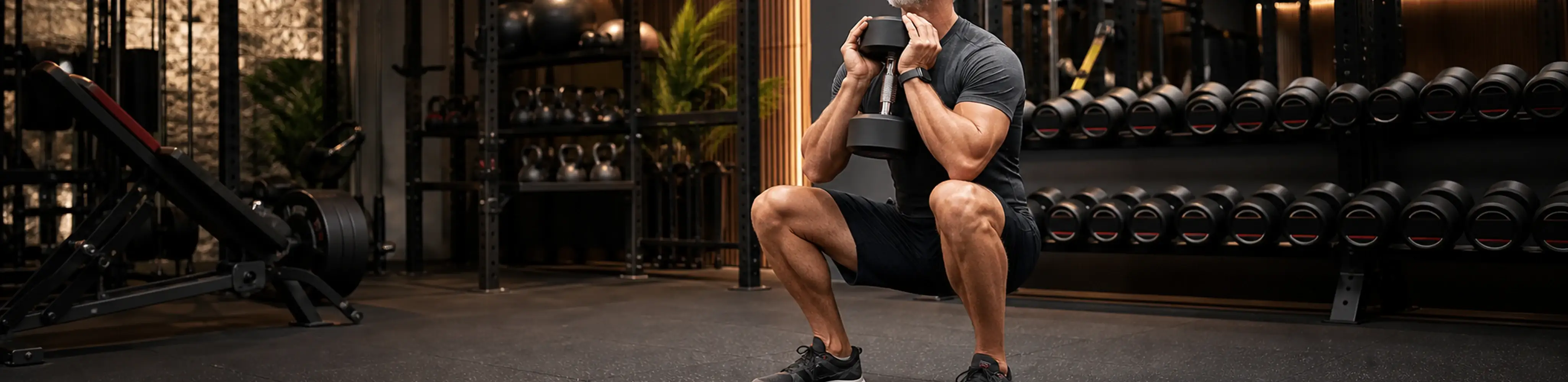
Yes, dumbbells can help support bone density because resistance training places controlled mechanical loads on bones and muscles. The body responds to repeated loading by maintaining and, in some people, increasing bone mineral density over time. Dumbbells are useful because the load can be adjusted in small steps and applied through squats, hinges, presses, rows, step-ups, and carries. They are not a cure for osteoporosis, and results depend on training intensity, consistency, nutrition, age, health status, and the skeletal sites being loaded.
This guide is for adults building a bone-supportive exercise routine, fitness professionals planning strength programs, and gym buyers choosing equipment for a broad member population. It separates established health evidence from practical coaching and equipment recommendations. People with osteoporosis, previous fragility fractures, significant joint problems, or long periods of inactivity should obtain individual medical or physiotherapy guidance before starting loaded exercise. For everyone else, the central principle is simple: use technically sound movements, progress the load gradually, and train consistently enough for the skeleton and muscles to adapt.
Quick Answer: Do Dumbbells Help With Bone Density?
Question: Do dumbbells help with bone density?
Answer: Dumbbell resistance training can help maintain or improve bone mineral density by exposing the skeleton to progressive mechanical loading. Multi-joint movements such as goblet squats, Romanian deadlifts, overhead presses, rows, step-ups, and loaded carries are especially useful because they load several regions while strengthening muscles that support balance. Benefits develop over months, not days, and vary by age, training dose, nutrition, and health. People with osteoporosis or fracture risk should use a clinician-approved program.
How Does Dumbbell Training Affect Bone Density?
Bone is living tissue. It is continually remodeled as old tissue is removed and new tissue is formed. Resistance exercise creates muscle tension and ground-reaction forces that signal bone to adapt. The response is site-specific: an exercise has the strongest effect on the bones that actually receive meaningful load.
The U.S. National Institute of Arthritis and Musculoskeletal and Skin Diseases identifies resistance training with free weights as a bone-strengthening activity. Research reviews also report that progressive resistance training can help maintain or modestly improve bone mineral density, although outcomes differ among populations and study designs. That is why a responsible answer is “dumbbells can help,” not “dumbbells guarantee denser bones.”
Why does lifting weights make bones stronger?
When a muscle contracts against a dumbbell, it pulls on its tendon and the attached bone. The body also experiences compression and bending forces as it supports and moves the load. If that stimulus is greater than the person routinely experiences—but still safe—the remodeling process may favor better bone strength. The same session also develops muscle and coordination, which can reduce fall risk. Bone adaptation is slow, so progressive training must be sustained and paired with adequate recovery.
Is bone density the same as bone strength?
No. Bone mineral density, usually measured by DXA, is an important indicator, but bone strength also depends on geometry, microarchitecture, material quality, and fall exposure. Dumbbell training may improve strength, balance, and confidence even when a scan shows only a small density change. Those functional benefits matter because fracture risk reflects both the condition of the skeleton and the likelihood and mechanics of a fall.
Which Dumbbell Exercises Are Best for Bone Health?
The best exercise selection loads the hips, spine, legs, shoulders, and arms through patterns the trainee can perform safely. A complete routine should not rely only on curls or light isolation movements.
| Exercise pattern | Dumbbell example | Main regions loaded | Practical purpose |
|---|---|---|---|
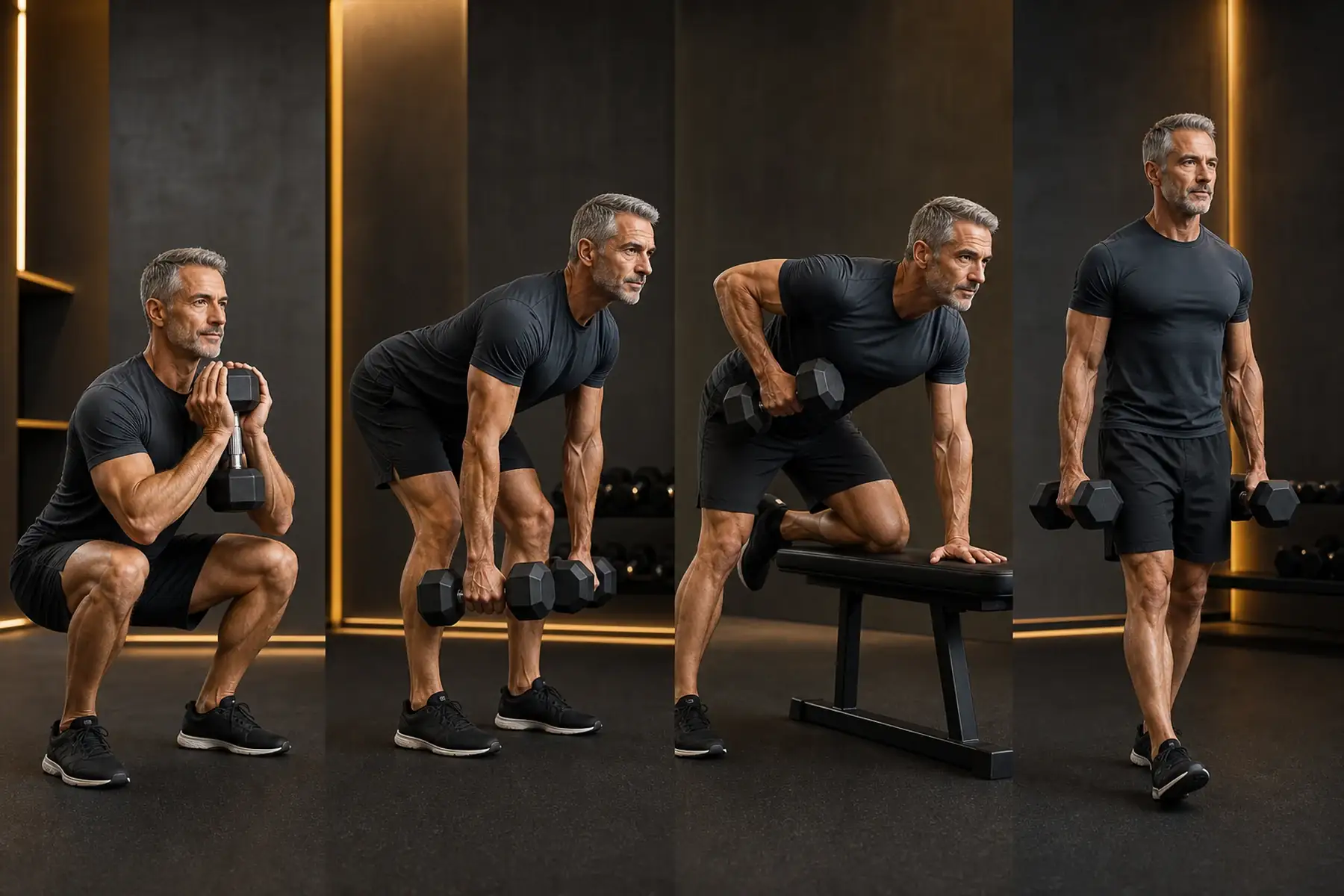
| Squat | Goblet squat | Hips, femur, spine | Lower-body strength and upright load bearing |
| Hinge | Romanian deadlift | Hips, spine, posterior chain | Hip strength and controlled trunk loading |
| Single-leg | Step-up or split squat | Hips, legs | Balance and side-to-side control |
| Push | Floor press or overhead press | Arms, shoulders, upper trunk | Upper-body loading and pressing strength |
| Pull | One-arm row | Arms, shoulder girdle, upper back | Posture and pulling strength |
| Carry | Farmer carry or suitcase carry | Hips, spine, arms | Whole-body bracing, grip, and walking capacity |
Are goblet squats good for bone density?
Goblet squats are a practical starting movement because the dumbbell is held close to the torso, the load is easy to change, and depth can be adjusted to the trainee's mobility. They load the hips and legs while asking the trunk to remain stable. For bone health, the set should eventually feel challenging rather than remaining permanently light. A box or bench can limit depth for beginners, while experienced trainees may progress to two-dumbbell front squats or split squats.
Do dumbbell carries strengthen bones?
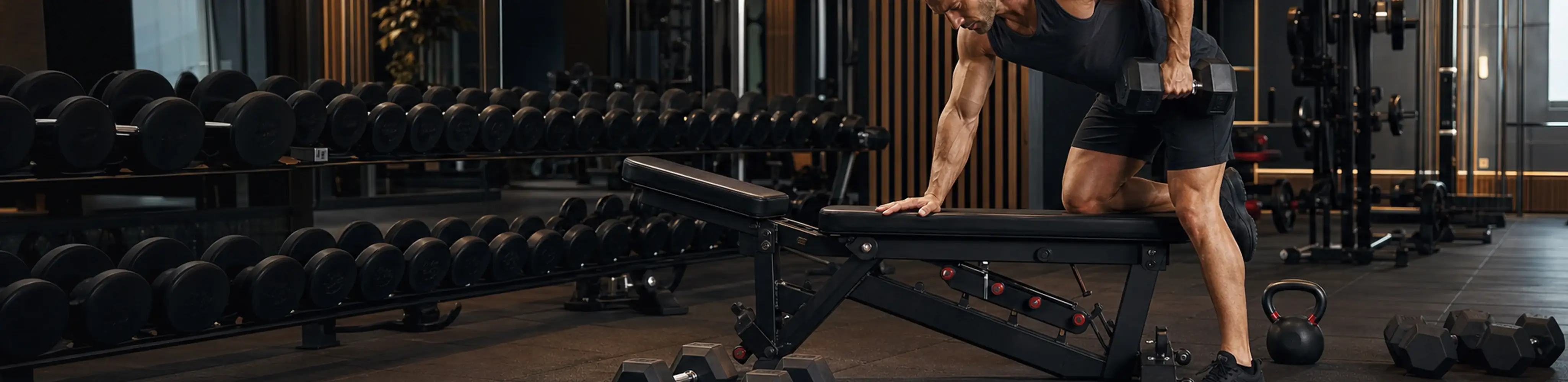
Loaded carries combine weight bearing with walking, grip, trunk stiffness, and balance. They may be especially useful for building practical strength and exposing the body to steady axial and lateral loading. A farmer carry uses two dumbbells; a suitcase carry uses one and creates an additional anti-side-bending demand. Carries should be performed in a clear lane with weights that can be controlled without leaning, rushing, or losing grip.
How Heavy Should Dumbbells Be for Bone Benefits?
There is no single correct dumbbell weight. The appropriate load is one that makes the target repetition range challenging while the trainee can maintain controlled technique. A very light weight may be suitable for learning, rehabilitation, or a deconditioned beginner, but the body eventually needs progressive overload to keep adapting.
Practical progression:
- Learn the movement with body weight or a light dumbbell.
- Choose a load that permits the planned repetitions with two or three good repetitions still possible.
- Add repetitions within the target range before adding weight.
- Move to the next dumbbell size when every set is controlled and repeatable.
- Reassess technique, pain, fatigue, and recovery after each increase.
Are light dumbbells enough to improve bone density?
Light dumbbells can be a useful entry point, especially for older adults, beginners, and people returning after inactivity. However, a load that never becomes challenging is unlikely to provide the same skeletal or muscular stimulus as progressive training. “Heavy” is relative: a 4 kg dumbbell can be demanding for one person and a warm-up for another. The goal is to progress toward meaningful effort without sacrificing technique or ignoring medical restrictions.
How often should I lift weights for bone health?
Two or three nonconsecutive full-body resistance sessions per week are a common practical framework. Current reviews in older adults suggest that regular, progressive training performed at least twice weekly can support skeletal benefits, but an individual program should account for recovery, age, medications, and training history. More sessions are not automatically better. Consistency, adequate loading, exercise variety, and recovery are more important than adding frequency without a plan.
What Does the Scientific Evidence Actually Show?
Scientific facts: Government health guidance recognizes resistance training, including free weights, as a bone-supportive activity. Systematic reviews generally find small positive or protective effects at the hip and lumbar spine in older adults, but results vary. Some trials show no meaningful change at certain sites or in specific groups. Bone adaptations are slower and less visually obvious than muscle gains.
What the evidence does not prove: It does not prove that one dumbbell exercise reverses osteoporosis, that every person responds equally, or that a short challenge produces a clinically important scan change. A dumbbell is the loading tool; the program dose and the trainee's health determine the response.
| Evidence question | Responsible conclusion |
|---|---|
| Can resistance training support bone density? | Yes, particularly when it is progressive and sustained. |
| Are results the same at every skeletal site? | No. Adaptation is site-specific and varies by exercise selection. |
| Will everyone gain measurable BMD? | No. Some people maintain density or gain functional benefits without a large scan change. |
| Is heavier always better? | No. Load must be challenging, technically controlled, and appropriate for the individual. |
| Can dumbbells replace medical treatment? | No. Exercise complements, but does not replace, prescribed osteoporosis care. |
How long does it take to improve bone density with weights?
Bone remodeling takes months. Training studies commonly assess outcomes after six months or longer, and visible strength improvements usually arrive before measurable skeletal changes. Treat bone health as a long-term practice. A sustainable plan performed throughout the year is more credible than a very aggressive program abandoned after several weeks. Follow-up DXA timing should be decided with a healthcare professional because small short-term changes may be within measurement variability.
How Can Beginners Train Safely With Dumbbells?
Start with movements that are stable, teachable, and easy to scale. A beginner does not need complex exercises or maximal loads. They need repeatable technique and a clear progression path.
Beginner safety checklist:
- Obtain medical guidance when there is osteoporosis, a fragility fracture, unexplained pain, balance impairment, or major cardiovascular disease.
- Use a clear floor area and stable shoes.
- Keep the load close to the body when learning squats and hinges.
- Avoid holding the breath for prolonged periods unless a qualified professional has taught an appropriate bracing method.
- Stop when pain is sharp, sudden, or different from normal muscular effort.
- Record exercises, loads, repetitions, and symptoms.
- Progress one variable at a time.
Can people with osteoporosis use dumbbells?
Many people with osteoporosis can perform resistance exercise, but the program should be individualized. Fracture history, spinal changes, balance, medication, and technique all affect exercise selection. Repeated loaded spinal flexion, uncontrolled twisting, sudden impacts, or a high risk of dropping a weight may be inappropriate for some individuals. A clinician or physiotherapist familiar with osteoporosis can determine safe movement ranges and progression. The objective is not to avoid all loading; it is to apply useful loading without creating unnecessary risk.
Dumbbells Versus Machines, Bands, and Barbells for Bone Health
Dumbbells are not the only effective tool. Their main strengths are accessibility, unilateral training, a natural range of motion, and small weight increments. Machines add stability and may help users who need simpler movement paths. Bands are portable but can be harder to quantify. Barbells allow larger total loads but usually require more space, racks, plates, and coaching.
| Equipment | Main advantage | Limitation | Best use |
|---|---|---|---|
| Dumbbells | Flexible, unilateral, scalable | Heavy sets require safe handling | General full-body resistance training |
| Machines | Stable and easy to learn | Fixed path may not suit everyone | Beginners, targeted work, busy facilities |
| Resistance bands | Portable and low cost | Loading is less standardized | Home programs and accessory exercise |
| Barbells | Efficient for high total loads | More setup, space, and technique | Experienced lifters and dedicated strength areas |
Are dumbbells better than resistance bands for bones?
Neither tool is universally better. Dumbbells provide a clearly labeled external mass and a consistent gravitational load, which makes progression straightforward. Bands provide increasing tension as they stretch and are useful when portability or joint-friendly setup is the priority. A well-designed band program can build strength, but commercial facilities often use dumbbells as the measurable foundation and bands as a complementary tool.
What Should Commercial Gyms Consider When Buying Dumbbells?
For a gym serving beginners, older adults, and experienced lifters, the equipment decision is about progression and usability as much as appearance. A complete run of closely spaced weights allows members to advance without oversized jumps. The commercial dumbbell buying guide explains product formats in more detail.
Expert equipment recommendations:
- Specify a logical weight range with smaller increments at the light end.
- Check weight marking legibility from the rack.
- Confirm handle diameter, knurling, and finish consistency across the set.
- Match head material to usage, odor expectations, flooring, and maintenance.
- Use racks that let members return weights without pinch hazards.
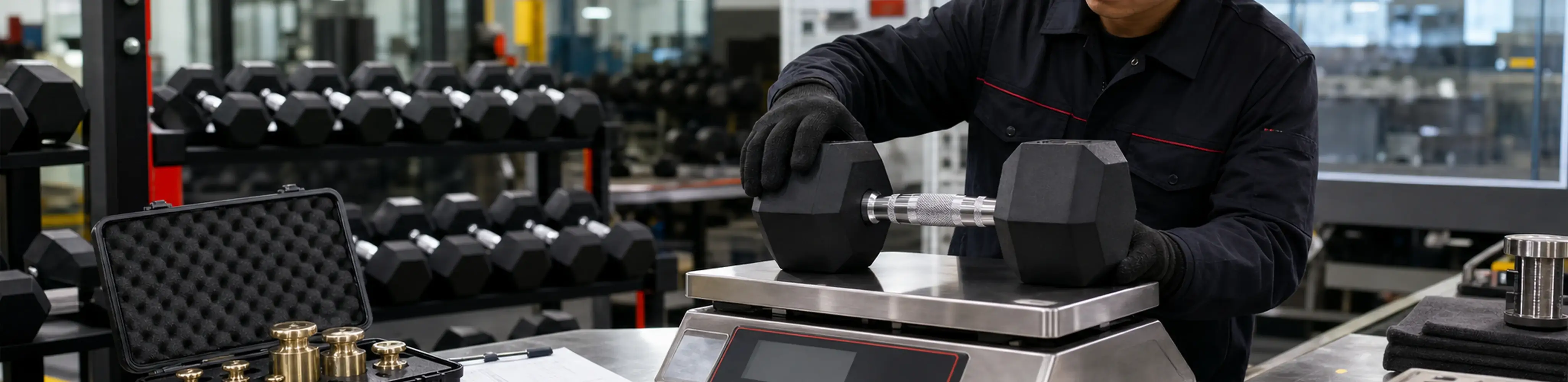
- Ask how the supplier verifies weight, handle alignment, surface finish, and packaging.
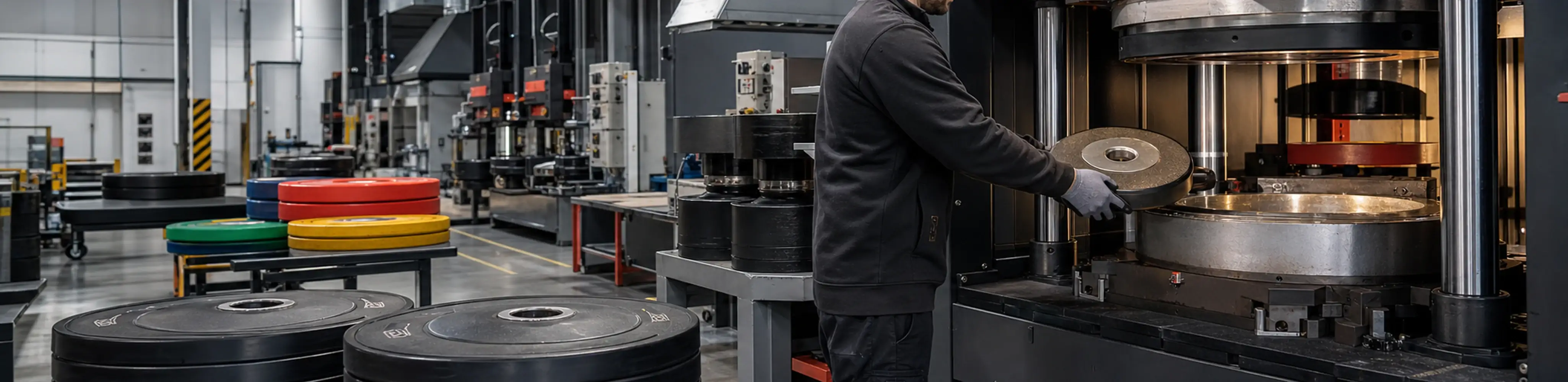
PowerBaseFit evaluates these issues through material selection, production checks, finish inspection, weight verification, and export packaging. Buyers can compare rubber hex dumbbells, commercial TPU dumbbells, the complete dumbbell range, and the factory process before preparing a project list.
Which dumbbells are best for older adult fitness areas?
A broad range is more important than one “senior” model. Lighter increments, high-contrast markings, secure grips, stable storage, and heads that do not roll are valuable. Hexagonal coated dumbbells often work well in mixed-use areas, while round commercial dumbbells suit dedicated racks and premium strength zones. The purchasing team should test how easily typical members can identify, lift, carry, and rerack each size.
Frequently Asked Questions About Dumbbells and Bone Density
Can dumbbells prevent osteoporosis?
Dumbbell training may help reduce age-related bone loss and supports muscle, balance, and function, but it cannot guarantee prevention of osteoporosis. Risk also depends on genetics, hormones, nutrition, smoking, alcohol use, body weight, medications, and medical conditions. Resistance exercise is best viewed as one part of a bone-health plan that may also include adequate calcium and vitamin D, weight-bearing activity, fall prevention, and prescribed treatment. Anyone at elevated risk should discuss screening and exercise with a healthcare professional.
Can I improve bone density after age 60 with dumbbells?
Adults over 60 can still improve strength and may maintain or improve bone mineral density with progressive resistance training. The starting load and movement choices should match current ability rather than chronological age alone. Two people of the same age may require very different programs. Begin with stable exercises, use gradual progression, and include balance work. If osteoporosis, arthritis, heart disease, or a previous fracture is present, obtain individual guidance before increasing intensity.
Do dumbbell curls increase bone density?
Curls load the forearm and upper arm and can strengthen the elbow flexors, but they should not be the foundation of a bone-health program. They do little for the hips and legs, where age-related bone loss and fall-related fractures are major concerns. Include multi-joint lower-body exercises, presses, rows, and carries, then use curls as an accessory. Bone adaptation is site-specific, so a whole-body program is more useful than repeatedly loading one small region.
Are adjustable dumbbells suitable for bone-health training?
Adjustable dumbbells can work well if the mechanism is secure, changes are easy, and the available range supports gradual progression. They save space in a home or small studio. Fixed dumbbells are often more efficient in commercial facilities because several users can train at once and there is no selector mechanism to reset. In either format, clear markings, stable handles, and a progression-friendly weight range matter more than the adjustment method itself.
Should I combine dumbbells with walking?
Yes. Walking supports general health, endurance, and regular weight bearing, while dumbbell training adds higher muscular tension and more targeted loading. The two activities address different needs and can coexist in a weekly plan. Depending on ability, impact exercise, stair climbing, or faster walking may provide an additional skeletal stimulus. A clinician should guide impact choices for anyone with osteoporosis, joint limitations, or a high fall risk.
Can dumbbells improve balance as well as bone health?
They can, particularly when used in split-stance exercises, step-ups, controlled single-leg patterns, and carries. Stronger legs and trunk can support steadier movement, but loaded balance work must be introduced carefully. Beginners should first demonstrate control near a stable support and avoid unstable surfaces while holding weights. Dedicated balance practice remains valuable; strength training does not replace every balance exercise, but it can improve the physical capacity used to recover from a loss of balance.
What dumbbell weight should a beginner buy?
A single weight rarely serves every movement. Most beginners can press, row, squat, and hinge with different loads. An adjustable pair or a small set with several increments is therefore more useful than one heavy pair. Test a weight that allows controlled repetitions without straining or changing posture. For facilities, provide closer spacing among lighter weights and a wider upper range so users can progress without outgrowing the area.
How do I know whether my program is working?
Track loads, repetitions, movement quality, balance, confidence, and day-to-day function. Increasing a dumbbell safely, completing more controlled repetitions, and finding stairs or carrying tasks easier are meaningful signs of progress. Bone density itself requires clinical measurement, usually DXA, and should not be inferred from soreness or appearance. A healthcare professional can interpret scan changes and decide whether the timing and measurement sites are comparable.
Sources and Next Steps
The health guidance in this article aligns with the NIAMS exercise and bone health resource and peer-reviewed resistance-training reviews indexed by PubMed. It is general education, not medical diagnosis.
For a commercial project, send PowerBaseFit the target user group, weight range, floor plan, rack preference, quantity, logo needs, and destination. Our team can help you compare materials, verify specification and packaging points, and plan an OEM or private-label free weight line.
Request a Dumbbell Catalog and Project Quote