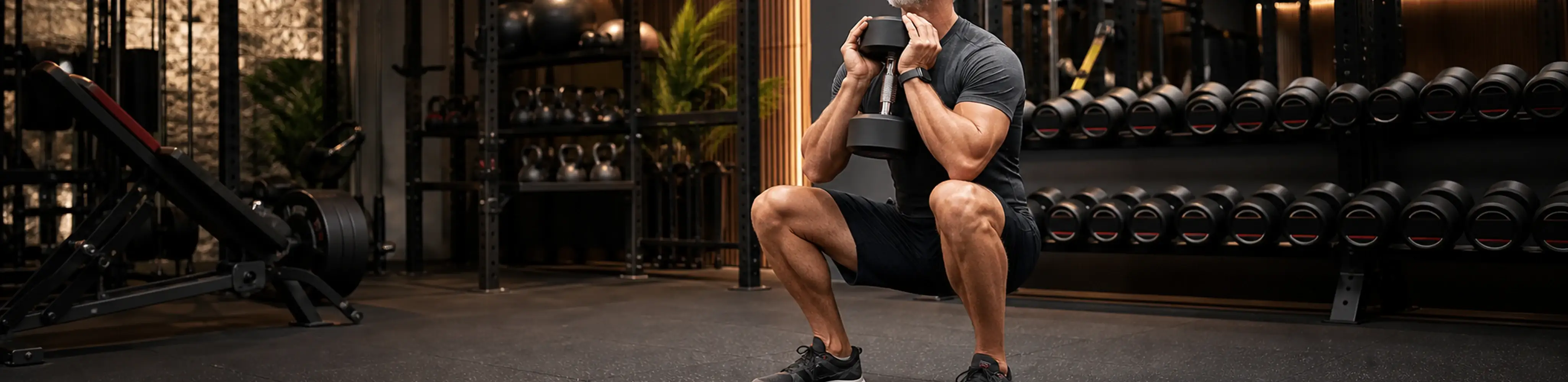
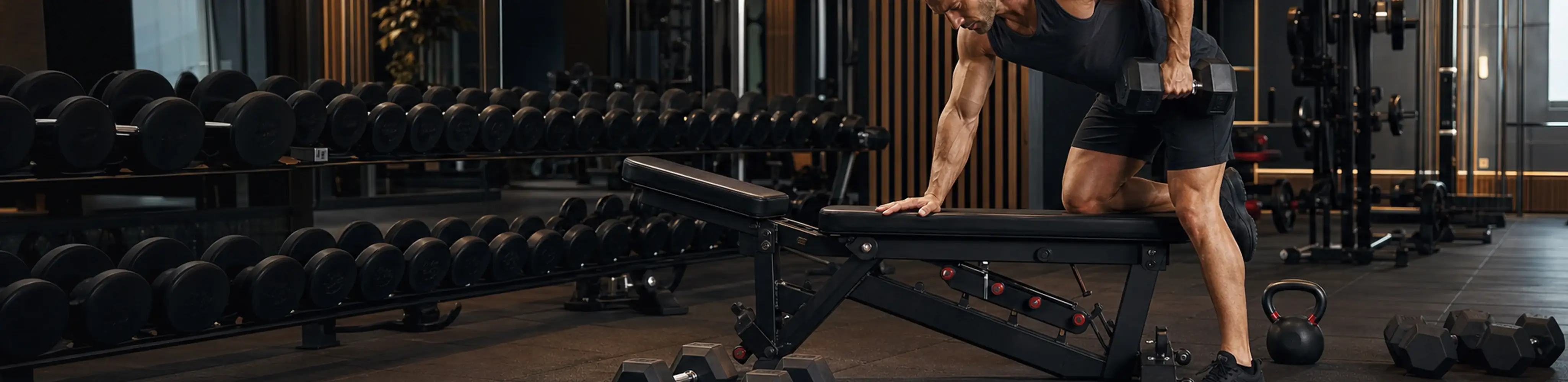
Yes, you can build muscle using only dumbbells. Muscle growth depends primarily on training the target muscles with enough effort and weekly volume, progressing the challenge over time, eating enough protein and energy, and recovering between sessions. Dumbbells can train every major movement pattern: squat, hinge, lunge, horizontal and vertical push, horizontal and vertical pull, carry, curl, and extension. They are therefore sufficient for a beginner, a home gym user, and many experienced lifters.
The practical limitation is not that dumbbells “stop working.” It is whether the available weights and exercise setups remain challenging as you become stronger. A light fixed pair may be outgrown quickly for legs and back. A broad fixed set or heavy adjustable pair offers a much longer progression path. This guide explains how to plan dumbbell-only hypertrophy training, which exercises cover each muscle group, how to progress without adding weight every week, and when a bench, rack, or barbell becomes useful. It also helps gym owners and distributors evaluate dumbbell ranges for muscle-building customers without turning the article into a product advertisement.
Quick Answer: Can You Build Muscle With Only Dumbbells?
Question: Can I build muscle with only dumbbells?
Answer: Yes. Dumbbells can build muscle when sets are performed with sufficient effort, the total weekly work is appropriate, and exercises become progressively harder. Use compound movements such as squats, Romanian deadlifts, split squats, presses, and rows, then add isolation work for shoulders and arms. Train all major muscle groups, record performance, and increase load, repetitions, range of motion, or set quality over time. Nutrition and recovery are essential, and your dumbbell range must be heavy enough to keep challenging you.
Why Are Dumbbells Effective for Muscle Growth?
Muscles respond to tension and repeated hard contractions, not to a specific equipment brand or machine category. Dumbbells provide external resistance through a controllable range of motion. They allow both arms or legs to work together or separately, make side-to-side differences visible, and can be positioned in ways that fit different body proportions.
Peer-reviewed reviews comparing free weights with machines generally find similar muscle hypertrophy when programs are appropriately matched. Strength gains are more specific to the equipment and movement practiced: train with dumbbells and you become especially skilled at dumbbell exercises. That supports a simple conclusion—dumbbells are fully capable of producing hypertrophy, provided the program is demanding and progressive.
Do dumbbells build as much muscle as machines?
They can. Research comparing free-weight and machine-based resistance training reports no consistent hypertrophy advantage for either mode when training variables are comparable. Machines offer stability and easy load changes; dumbbells offer movement freedom and unilateral options. Choose based on exercise fit, availability, preference, and the ability to train close enough to muscular fatigue safely. A commercial gym benefits from both, but a person with only dumbbells can still build substantial muscle.
Do dumbbells activate more stabilizer muscles?
Dumbbells often require more active control because each implement moves independently. That can increase the stabilization demand in presses, rows, and single-leg exercises. More instability is not automatically better for hypertrophy: excessive wobbling can reduce the force the target muscle produces. Use a stable bench, stance, and range of motion so stabilization supports the exercise instead of dominating it.
Which Muscles Can You Train With Dumbbells?
A well-planned dumbbell program can cover the chest, back, shoulders, biceps, triceps, quadriceps, hamstrings, glutes, calves, forearms, and trunk. The key is to select at least one exercise for each major movement pattern and use variations that match the available load.
| Muscle group | Primary dumbbell exercises | Useful progression |
|---|---|---|
| Chest | Floor press, bench press, incline press, fly | Greater load, deeper safe range, controlled pause |
| Back | One-arm row, chest-supported row, pullover | Heavier row, longer stretch, additional set |
| Shoulders | Overhead press, lateral raise, rear-delt raise | More reps, stricter form, mechanical drop set |
| Quadriceps | Goblet squat, front squat, split squat, step-up | Unilateral work, heel elevation, greater load |
| Hamstrings and glutes | Romanian deadlift, single-leg RDL, hip thrust | Longer range, slower eccentric, heavier pair |
| Arms | Curl, hammer curl, overhead extension, skull crusher | Full range, added reps, heavier increment |
| Calves and grip | Standing calf raise, farmer carry | Single-leg work, longer carry, heavier load |
Can you train your back with only dumbbells?
Yes. Rows are the main foundation: one-arm rows allow a strong supported position, bent-over rows train both sides together, and chest-supported rows reduce lower-back fatigue. Pullovers add shoulder extension and can train the lats through a long range. The main gap is a true vertical pull such as a pull-up or pulldown. If no pull-up bar is available, vary row angles and include pullovers, but consider adding a bar later for a more complete pulling menu.
Can you build legs with only dumbbells?
Yes, although strong trainees may eventually need heavy dumbbells or more demanding unilateral exercises. Goblet squats are accessible, Romanian deadlifts load the posterior chain, and split squats or step-ups make moderate dumbbells challenging because one leg does most of the work. Longer ranges of motion, pauses, slower lowering, and higher repetitions can extend progression. Grip may become the limiting factor in heavy hinges, so straps or a different setup may be useful for advanced users.
What Are the Best Dumbbell-Only Exercises?
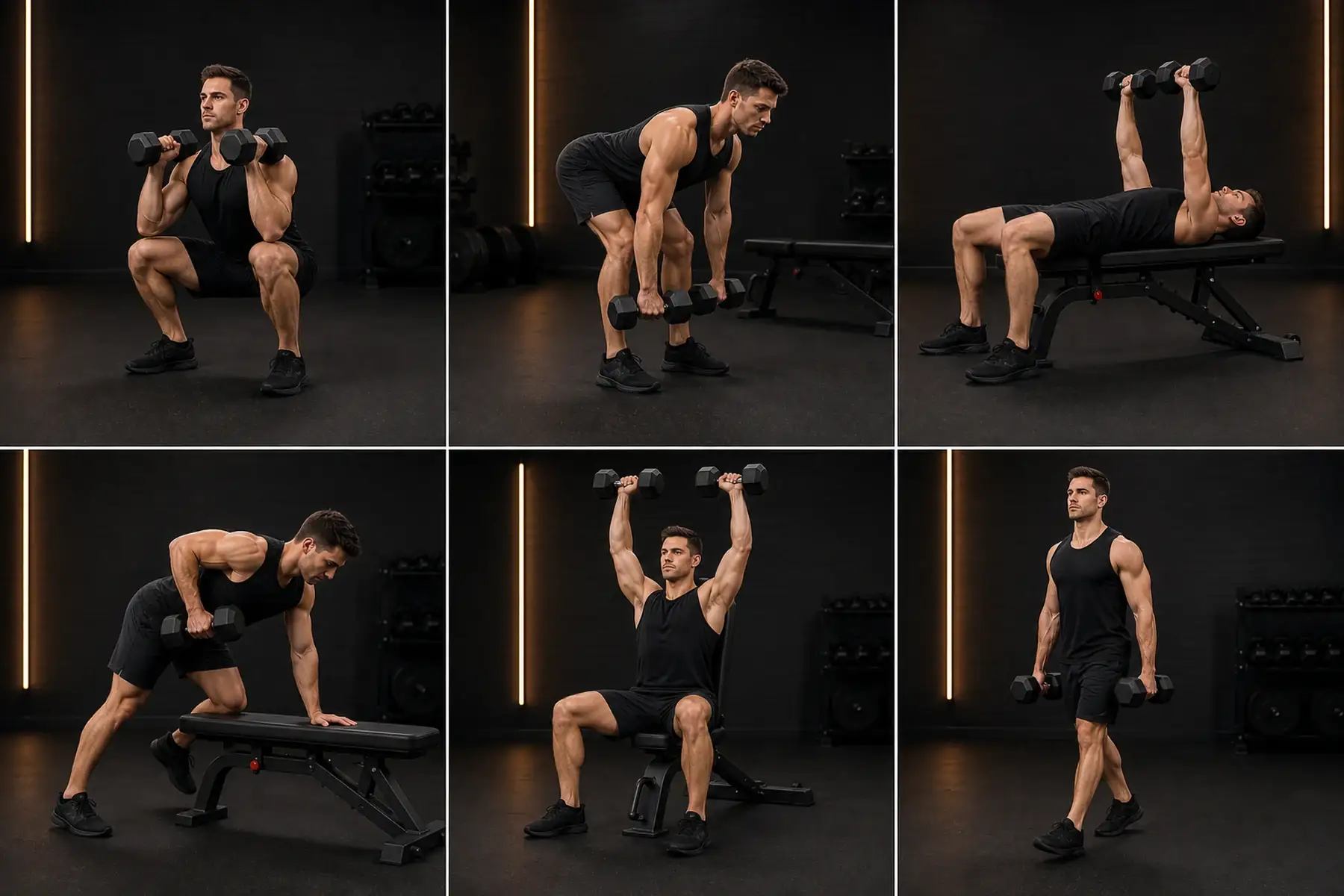
The best exercises are stable, loadable, comfortable, and suited to the target muscle. A short routine of repeatable movements is more productive than changing exercises every session.
Core dumbbell-only exercise list:
- Goblet squat or two-dumbbell front squat
- Romanian deadlift
- Split squat or reverse lunge
- Dumbbell floor press or bench press
- One-arm row or chest-supported row
- Standing or seated overhead press
- Lateral raise
- Curl and overhead triceps extension
- Standing calf raise
- Farmer or suitcase carry
Is a dumbbell floor press enough for chest growth?
The floor press can build the chest and triceps, especially for trainees without a bench. The floor limits shoulder extension at the bottom, which can feel comfortable and makes setup safer, but it also shortens the range compared with many bench-press variations. For complete development, use controlled floor presses and, when possible, add push-ups or a stable adjustable bench that allows a deeper comfortable range and incline angles.
Are dumbbell squats enough for muscle growth?
They can be, if the variation remains hard enough. A goblet squat may eventually be limited by how much weight you can hold at the chest. At that point, use two dumbbells in a front-rack position, split squats, Bulgarian split squats, step-ups, or slower high-repetition sets. If those options no longer provide practical overload, a barbell or machine can make heavy bilateral leg training more efficient, but it is not required for early and intermediate progress.
How Should You Progress a Dumbbell-Only Workout?
Progressive overload means increasing the training challenge over time. It does not require adding weight every session. Dumbbell increments can be large relative to a small exercise, so use a progression system that includes repetitions and technique.
Double-progression method:
- Choose a repetition range, such as 8–12.
- Start with a weight you can control for the lower end of the range.
- Add one or more repetitions across sessions while maintaining the same range of motion.
- When all sets reach the upper end with one to three repetitions in reserve, move to the next dumbbell size.
- Return to the lower end of the range and build again.
Other useful overload tools include adding a set, increasing range of motion, lengthening the controlled lowering phase, pausing in the hardest position, improving stability, or choosing a unilateral variation. Use one change at a time so the training log remains meaningful.
How close to failure should dumbbell sets be?
Most muscle-building sets should end with only a few technically sound repetitions left, but not every set must reach complete failure. Training to failure can increase fatigue and make free-weight technique less stable. Beginners should learn to recognize effort and stop before form changes. Experienced trainees may use occasional failure safely on simple movements such as curls or lateral raises. Compound exercises should prioritize control, a safe setup, and repeatable performance.
What if my dumbbells are too light?
Use more repetitions, slower eccentrics, pauses, one-and-a-half repetitions, shorter rest periods for isolation work, and unilateral exercises. Pre-fatiguing a muscle with an isolation movement can also make a compound movement harder. These methods extend the life of a light set, but they do not create unlimited progression. If leg or back sets require extremely high repetitions and cardiovascular fatigue becomes the main limitation, heavier dumbbells are the practical answer.
What Is a Good Dumbbell-Only Weekly Plan?
Beginners often progress with three full-body sessions per week. Intermediate trainees may prefer an upper/lower or four-day split. The best schedule is one that trains each major muscle group regularly and leaves enough recovery.
| Day | Exercise | Sets × reps | Focus |
|---|---|---|---|
| Monday | Goblet squat, floor press, one-arm row, RDL, lateral raise | 2–4 × 6–15 | Full body A |
| Wednesday | Split squat, overhead press, chest-supported row, hip thrust, curl | 2–4 × 8–15 | Full body B |
| Friday | Step-up, bench or floor press, RDL, row, triceps extension, carry | 2–4 × 8–20 | Full body C |
This is a framework, not a prescription. Start near the lower end of the set range, keep one or two rest days between hard sessions, and adjust around training history. A novice does not need maximum weekly volume. Productive sets, steady progression, and adherence are the priorities.
How many sets per muscle should I do with dumbbells?
There is no universal number. Beginners can grow with a modest amount of hard training, often several direct sets per muscle each week. More experienced trainees may require more volume, but adding sets only helps when recovery and performance remain adequate. Count how many demanding sets a muscle receives from compound and isolation exercises, monitor progress for several weeks, and adjust gradually rather than copying the highest-volume program online.
Do You Need a Bench for Dumbbell Training?
No. Floor presses, standing presses, rows supported on a chair only if the chair is genuinely stable, squats, lunges, hinges, curls, extensions, and carries can create a complete program. A purpose-built adjustable bench expands exercise options and provides a safer, more consistent support than household furniture.
A bench enables incline and flat presses, chest-supported rows, seated presses, supported rear-delt work, hip thrusts, and split-squat setups. For a commercial gym, bench stability, pad grip, height, adjustment mechanism, transport wheels, and load rating should match the dumbbell area.
Can I train at home with only adjustable dumbbells?
Yes. Adjustable dumbbells are space-efficient and can cover a wide range if the maximum load is adequate. Check that the selector or locking mechanism remains secure during presses, rows, and carries. Consider handle length, change speed, usable increments, and whether the dumbbell can be placed on the floor safely. A mat protects the room but does not make a non-drop design suitable for dropping.
What nutrition and recovery support muscle growth?
Training creates the stimulus; food and recovery support adaptation. Consume enough total energy for your goal and distribute high-quality protein across the day. Sleep and rest days affect performance, appetite, and recovery. Supplements cannot rescue an inconsistent program or chronic under-eating.
Practical recovery checklist:
- Eat protein-rich meals consistently.
- Include carbohydrates around demanding sessions when helpful for performance.
- Hydrate according to climate and activity.
- Sleep on a regular schedule.
- Keep at least one full rest day when fatigue is accumulating.
- Reduce volume temporarily if performance, motivation, and joint comfort all decline.
What Are the Limitations of Dumbbell-Only Training?
Dumbbells have four practical limitations. First, available load may become insufficient for strong legs and backs. Second, getting very heavy dumbbells into position can be awkward. Third, grip may fail before the target muscles in hinges and carries. Fourth, there is no direct substitute for every cable, machine, or vertical-pulling exercise.
These are programming constraints, not evidence that dumbbells cannot build muscle. Many can be managed through unilateral exercises, a bench, straps, a pull-up bar, or a wider dumbbell range. Equipment should solve an actual bottleneck rather than being purchased because a program looks more “complete” with more machines.
When should I add a barbell or machine?
Add equipment when it makes progression safer, more efficient, or more enjoyable. A barbell is useful when heavy squats, deadlifts, or presses outgrow the dumbbell setup. A cable or pulldown adds vertical pulling and resistance angles. Machines can reduce stabilization demands and make targeted high-effort sets easier. None of these additions invalidate dumbbell training; they broaden the exercise menu.
What Should Gyms and Buyers Look for in Dumbbells?
Muscle-building users need a progression path. A commercial set should cover light isolation work, moderate pressing and rowing, and heavy lower-body training without disruptive gaps. The commercial dumbbell selection guide explains the broader sourcing decision.
Expert buying recommendations:
- Use smaller increments through the most frequently used weight range.
- Choose handles that remain comfortable during high-volume training.
- Confirm weight markings can be read quickly from the rack.
- Match round or hex heads to rack design and floor use.
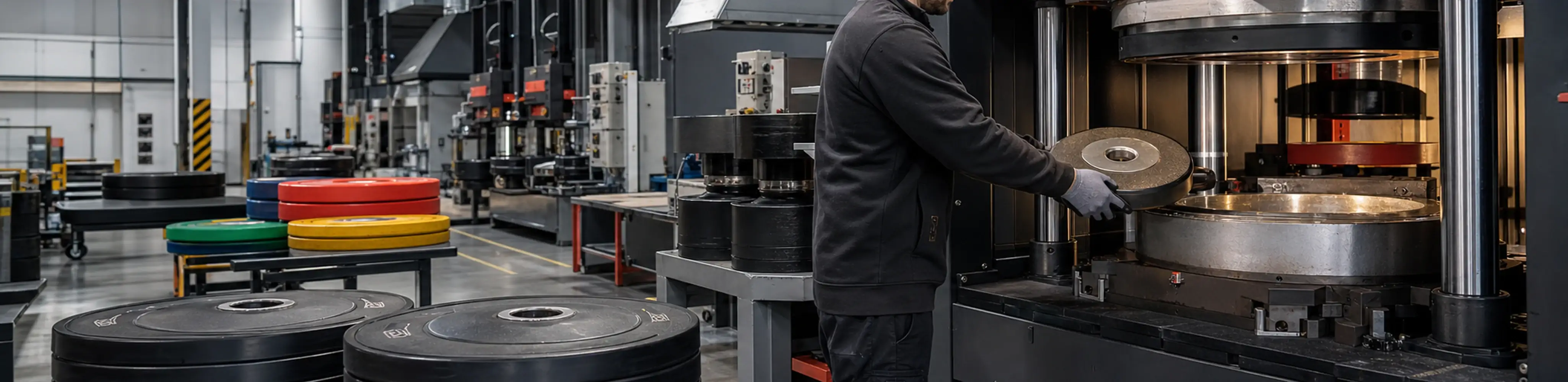
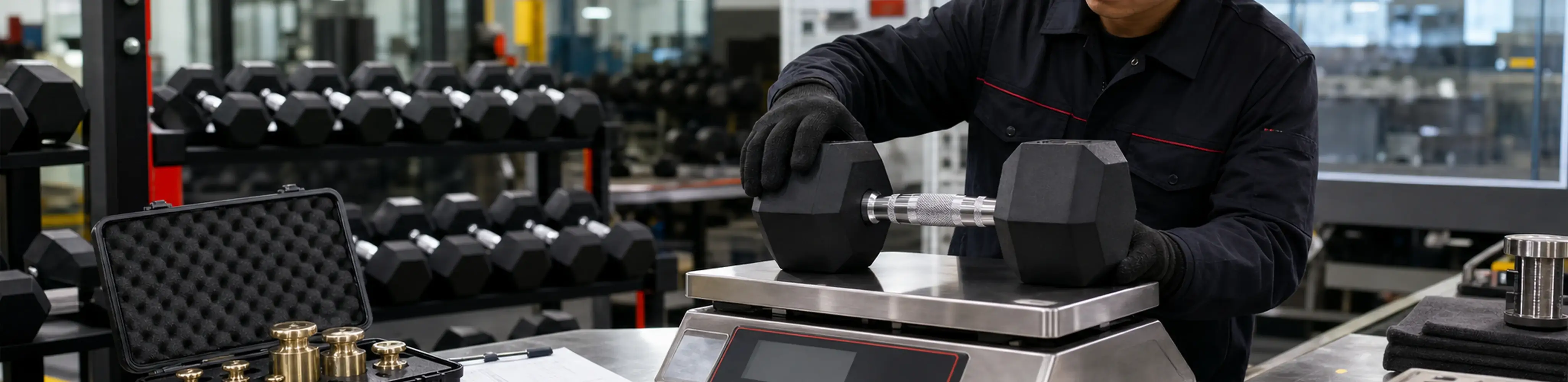
- Verify head-to-handle connection, surface consistency, and weight checks.
- Plan spare units or repeat-order consistency for high-traffic clubs.
- Specify export packaging that protects both heads and handles.
PowerBaseFit offers rubber hex dumbbells, classic rubber round dumbbells, TPU commercial dumbbells, adjustable dumbbells, and complete dumbbell lines. Buyers can also review the factory and prepare an OEM range with consistent logos, units, colors, racks, and packaging.
What weight range does a commercial dumbbell area need?
The answer depends on the facility. Hotels and rehabilitation-focused spaces may emphasize lighter increments, while bodybuilding and performance gyms need a much higher top end. Review member profiles, anticipated peak use, floor area, and the exercises members perform. Duplicate popular middle weights may reduce waiting in a busy club. Ask the supplier to quote the complete piece count and total shipment weight, not only a per-kilogram price.
Frequently Asked Questions About Dumbbell-Only Muscle Building
Can beginners build muscle with 5 kg dumbbells?
Some beginners can, particularly for shoulders, arms, and high-repetition upper-body work. The same 5 kg may be too light for squats, Romanian deadlifts, and rows. Muscle growth depends on whether the exercise approaches meaningful effort, not the number printed on the head. Use slower repetitions and unilateral movements initially, then obtain heavier options when sets become long without challenging the target muscle.
Can I get a big chest with only dumbbells?
Dumbbell presses and fly variations can build a large, strong chest when load, range of motion, effort, and weekly volume progress. A stable bench expands the available angles, while floor presses and push-ups work without one. Genetics, body size, training age, and nutrition influence how “big” someone becomes. Prioritize repeatable pressing technique and gradual overload rather than constantly changing angles.
Can dumbbells build muscle after age 50?
Yes. Adults can gain muscle and strength later in life, although recovery, joint history, medical conditions, and training experience affect the plan. Begin with manageable volume, stable movements, and controlled ranges. Progress gradually and include lower-body training, not only light arm exercises. Medical guidance is appropriate after long inactivity or when cardiovascular, neurological, bone, or joint conditions are present.
Is 30 minutes of dumbbell training enough?
Thirty focused minutes can be enough, especially for a beginner using compound exercises and limited rest. Session length is less important than productive weekly work. Use two to five movements, prepare the equipment before starting, and record performance. An advanced trainee with more exercises and volume may need longer sessions, but extra time is not automatically extra stimulus.
Should I use one dumbbell or two?
Both options are useful. One dumbbell works well for goblet squats, one-arm rows, suitcase carries, pullovers, and unilateral presses. Two dumbbells allow heavier total loading and symmetrical presses, rows, squats, hinges, and carries. Alternating and one-sided exercises can expose imbalances, while two-dumbbell movements save time. Choose the version that is stable and loadable.
Can I build muscle without lifting very heavy dumbbells?
Yes. A range of loads can build muscle when sets are sufficiently hard and technique remains controlled. Moderate and lighter loads usually require more repetitions to approach the same effort. Very light weights may make discomfort or cardiovascular fatigue limit the set before the target muscle. Use a load that lets you feel and control the intended movement while progressing over time.
How long before I see muscle from dumbbell workouts?
Strength and coordination often improve within the first several weeks, while visible muscle gain usually requires months of consistent training. Lighting, body fat, hydration, and measurement method can distort short-term impressions. Track circumference, photos under similar conditions, body weight, and exercise performance over longer intervals. If neither repetitions nor load improve, review training effort, volume, nutrition, and sleep.
Are fixed or adjustable dumbbells better for hypertrophy?
Both can build muscle. Fixed dumbbells are fast to change, durable, and ideal for supersets or shared commercial spaces. Adjustable models save space and cost for one or two home users. Evaluate maximum weight, increment size, balance, handle comfort, locking security, and how safely the unit can be set down. The better choice is the one that supports consistent progression in the available space.
Evidence and project next steps
The training conclusion is supported by systematic reviews comparing free-weight and machine training and research on resistance-training load and hypertrophy. The practical program is general education and should be adapted to the individual's health and experience.
For a gym, distributor, or private-label project, send PowerBaseFit the required weight range, quantity per size, head style, handle preference, rack plan, logo, packaging, and destination. We can review the specification and quality-control points for a coherent muscle-building equipment line.
Plan a Commercial Dumbbell Range