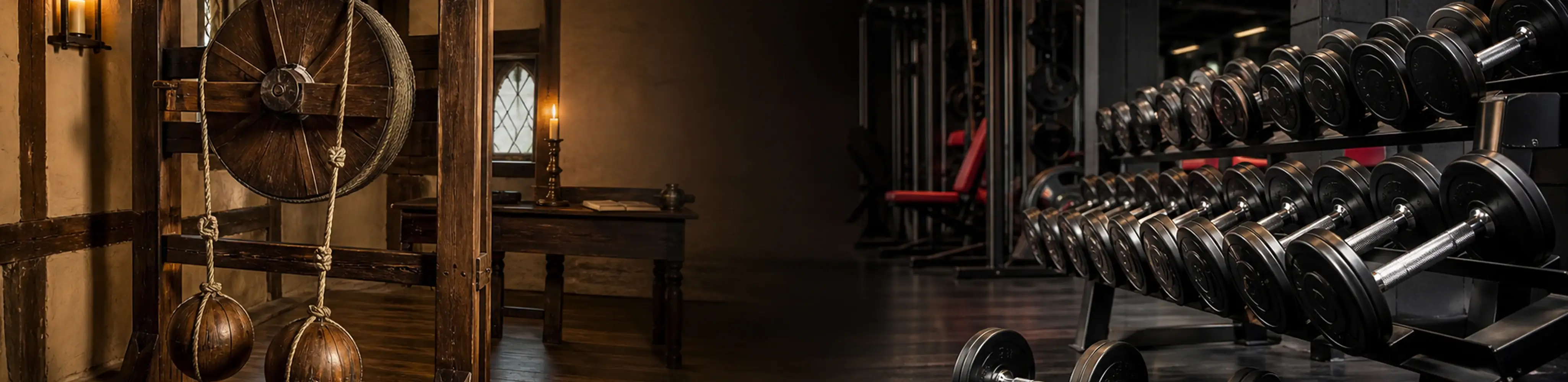
A dumbbell is called a “dumb bell” because the name originally referred to a silent—or “dumb”—bell-ringing exercise apparatus. In early eighteenth-century England, people could imitate the pulling motion used to ring a church bell without producing the bell's sound. The term was later transferred to the compact hand-held weights we now recognize as dumbbells. In this historical use, “dumb” meant mute or silent, not unintelligent.
That short answer explains the word, but the equipment's evolution is more interesting than the popular one-line story suggests. Early references do not give us a perfect engineering drawing of every apparatus, and historians are careful about connecting each stage. What is well supported is the language: “dumb-bell” appears in English exercise writing by 1711, and by the late eighteenth century it was used for weighted bars held in the hands. Modern dumbbells preserve the old name even though their forms, materials, manufacturing methods, and applications have changed dramatically. This guide explains the established history, separates it from common myths, and shows how today's cast iron, steel, rubber, chrome, TPU, and CPU products developed into a major commercial fitness category.
Quick Answer: Why Is It Called a Dumbbell?
Question: Why is it called a dumbbell?
Answer: The word “dumbbell” comes from an old exercise device that reproduced the movement of ringing a bell but made no sound. “Dumb” meant silent, and “bell” referred to the bell-ringing mechanism. The term appeared in English exercise writing in the early 1700s and later became the name for a short hand-held bar with weight at both ends. The modern product no longer resembles the original apparatus closely, but the historical name remained.
What Did “Dumb” Originally Mean in Dumbbell?
In the compound “dumb-bell,” the adjective “dumb” carried its older sense of unable to speak or silent. It described a bell-related device that did not ring. The word was not a judgment about the intelligence of the equipment or the person using it.
This matters because modern readers often interpret the name through today's informal meaning of “dumb.” Historical language works differently. Many product names outlive the context that first made them obvious. Once “dumbbell” became established as an exercise term, users no longer needed to know anything about church bells to understand what the object was.
Does dumbbell mean a bell that cannot ring?
Indirectly, yes. The original exercise apparatus simulated the physical work of bell ringing without the sound-producing bell. Calling it a dumb, or silent, bell was a practical description. The name then shifted from the larger mechanism to portable hand weights. A modern dumbbell does not contain a silenced bell, and its heads were not named simply because they look like bells; the term came through the earlier exercise tradition.
Is the word dumbbell offensive?
In fitness equipment, “dumbbell” is a standard neutral product term with a specific historical origin. Its first element reflects an older meaning of “silent.” The same word can be insulting when directed at a person, but that later usage does not define the equipment name. Manufacturers, coaches, standards documents, and buyers around the world use “dumbbell” as the accepted name for a one-hand free weight.
When Was the Word Dumbbell First Used?
One of the best-known early printed references appears in a 1711 issue of *The Spectator*, where English essayist Joseph Addison described exercise with a “dumb bell.” Etymological sources drawing on the Oxford English Dictionary place the hand-weight sense later in the eighteenth century, around the 1780s.
The cautious interpretation is that the term first belonged to a bell-ringing-style exercise machine and was then applied to portable weights. We should not imagine a single inventor unveiling the exact modern dumbbell on one documented date. Equipment vocabulary often develops through workshops, training practice, and repeated usage before designs become standardized.
Did Joseph Addison invent the dumbbell?
There is no solid reason to credit Addison as the sole inventor of the dumbbell. His 1711 writing is valuable because it documents the term and the exercise practice. Recording a device is not the same as inventing it. The exact form of the apparatus described in early sources is also debated. A historically responsible article says Addison provided an early written reference, not that he personally created every feature of the modern dumbbell.
Were dumbbells invented for church bell ringers?
The name is connected to practice that imitated bell ringing, and such exercise could build the shoulders, back, arms, and grip used by ringers. However, popular retellings often add unsupported details, such as people simply removing clappers from two bells and attaching them to a handle. The better-supported description is a weighted mechanism or flywheel operated like a bell but without a sounding bell. Later hand weights inherited the name.
What Did the First Dumbbell Look Like?
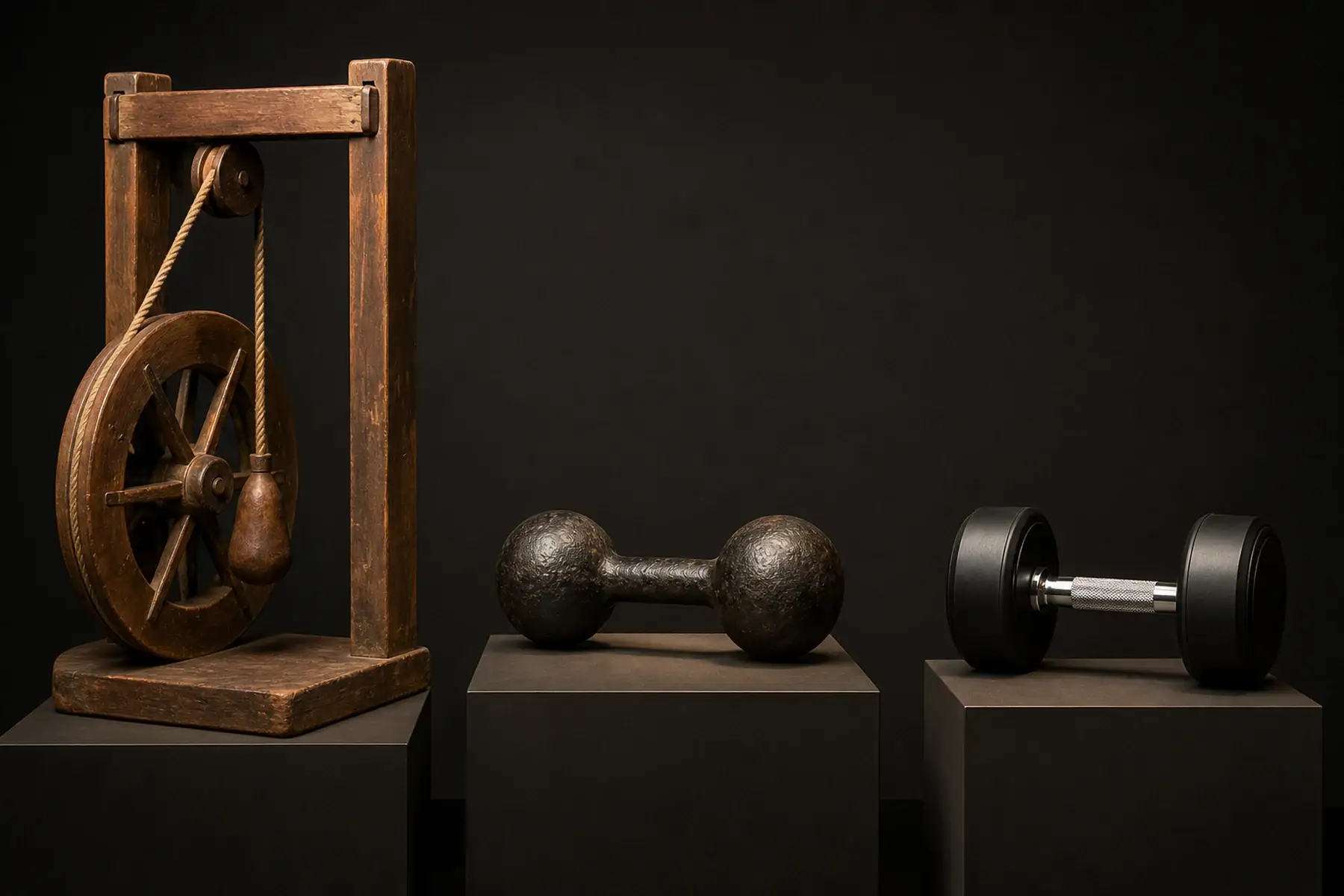
Early “dumb bell” equipment was likely larger and mechanically different from today's one-hand weights. Historical descriptions refer to pulling or ringing the device indoors and to a weighted wheel or spindle moved with a rope. By the late eighteenth and nineteenth centuries, hand-held weighted bars with enlarged ends became recognizable exercise tools.
The basic physics of the modern format is straightforward: a short handle places mass on both sides of the hand. This keeps the center of mass close to the grip, allows one-handed movement, and makes pairs useful for symmetrical or unilateral exercise. Materials and head profiles then diversified according to manufacturing technology and training needs.
| Period | Typical concept | What changed |
|---|---|---|
| Early 1700s | Silent bell-ringing exercise apparatus | Established the “dumb bell” name |
| Late 1700s | Portable weighted bars for exercise | Term transferred to hand-held weights |
| 1800s | Cast and adjustable iron designs | More repeatable commercial production |
| Early–mid 1900s | Plate-loaded and fixed gym sets | Broader strength-training use |
| Late 1900s | Rubber, vinyl, chrome, and studio styles | Better floor protection and market segmentation |
| Today | CPU, TPU, urethane-style, steel, and selectorized systems | Precision, branding, durability, and space efficiency |
Did ancient Greeks use dumbbells?
Ancient Greeks used hand-held weights called *halteres*, particularly in jumping and exercise. They are part of the longer history of resistance tools, but they were not called dumbbells and did not directly create the English word. It is useful to distinguish the history of weighted objects from the history of a specific name. Humans trained with stones, clubs, and hand weights long before the term “dumbbell” appeared.
How Did Dumbbells Evolve Into Modern Gym Equipment?
Three developments shaped the category: repeatable metal casting and machining, the growth of physical culture and commercial gyms, and protective polymers that changed how weights looked and behaved on indoor floors.
Early fixed iron dumbbells were durable but could chip finishes and damage flooring. Plate-loaded handles gave users more adjustment but required collars and loose plates. Fixed commercial sets improved speed and organization. Rubber and polymer-coated heads reduced noise, protected surfaces, and created space for colored markings and logos. Precision-machined steel and chrome models served premium clubs, while selectorized adjustable systems addressed compact home and hospitality spaces.
Why do modern dumbbells have different head shapes?
Shape affects storage, movement, manufacturing, and market position. Hex heads resist rolling and work well for floor exercises. Round heads fit saddle-style commercial racks and create a traditional strength-room appearance. Twelve-sided heads offer a stable profile with a more machined aesthetic. Square or compact heads support distinctive branding and storage formats. No shape is automatically best; the right choice depends on flooring, rack type, exercises, user volume, and product-line strategy.
Why are some dumbbells coated in rubber or polyurethane?
Coatings protect the metal core, reduce impact noise, improve grip on the head, and help protect racks and floors. Rubber is common in value-focused commercial and home-gym ranges. PU, CPU, and TPU systems are chosen for different combinations of abrasion resistance, appearance, odor expectations, color, and branding detail. The exact performance depends on compound formulation, molding control, core design, and normal use—not only the material label.
What Is the Difference Between a Dumbbell, Barbell, and Kettlebell?
These names share the “bell” element, but the equipment behaves differently. A dumbbell is normally held in one hand with the mass distributed around a short handle. A barbell is long enough for two-handed lifting and accepts or incorporates weight on both ends. A kettlebell has a handle above a compact mass, placing its center of mass outside the hand.
| Equipment | Grip and mass position | Common strengths | Typical commercial area |
|---|---|---|---|
| Dumbbell | One hand; mass on both sides of grip | Unilateral work, pressing, rows, full-body versatility | Dumbbell zone, studio, hotel gym |
| Barbell | Two hands; weight at ends of long shaft | High total load, Olympic and power lifts | Platforms, racks, strength zone |
| Kettlebell | One or two hands; mass below handle | Swings, carries, ballistic and offset work | Functional training zone |
Was the barbell named after the dumbbell?
The English exercise term “dumbbell” predates “barbell.” As strength equipment developed, “barbell” became a logical name for a longer bar carrying weight. The relationship is linguistic and functional: both are free weights with mass arranged around a grip, but the barbell's longer shaft changes loading, exercise selection, and storage.
How Are Dumbbells Made Today?
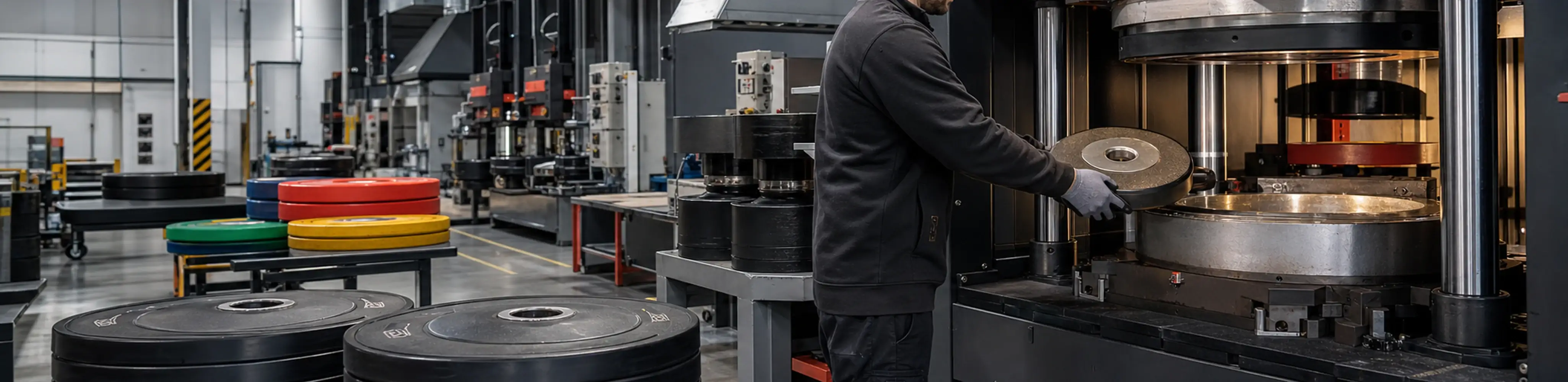
Modern production depends on the product type. A fixed cast iron dumbbell may use a cast head and metal handle with a protective finish. A rubber hex dumbbell combines a metal core and handle assembly with molded rubber heads. A steel dumbbell may use cut, machined, polished, and plated components. Polymer commercial dumbbells often use molded outer materials around a precisely controlled core.
Typical production and quality sequence:
- Confirm weight, dimensions, material, finish, markings, and packaging.
- Prepare or cast the metal core and handle components.
- Machine grip surfaces, connection points, or precision faces as required.
- Mold, coat, plate, or polish the product.
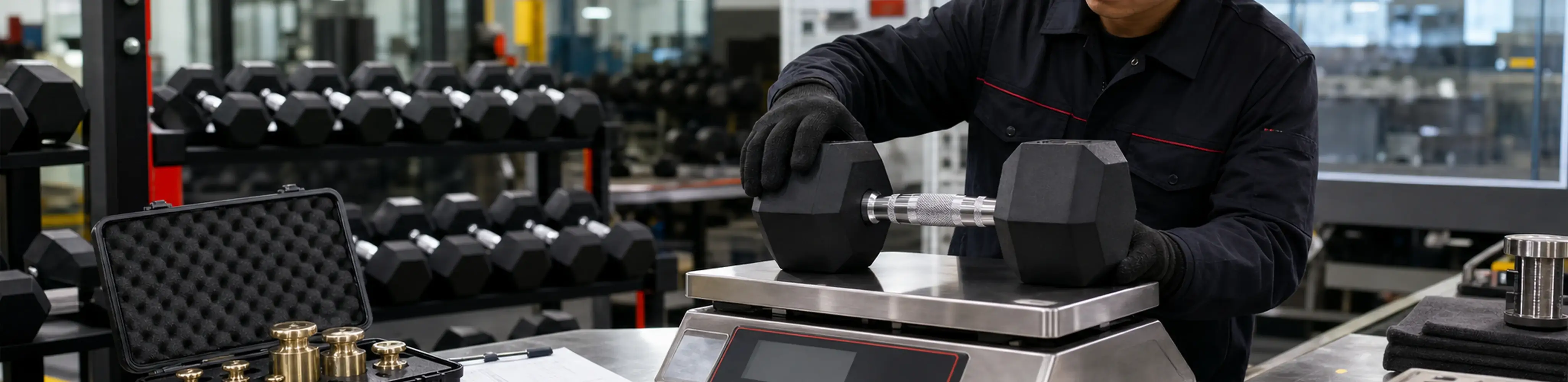
- Inspect weight, alignment, surface quality, markings, and dimensions.
- Protect each unit for storage and international transport.
PowerBaseFit's factory work covers free weight material selection, forming and machining, surface finishing, weight checking, appearance inspection, OEM marking, and export packaging. Buyers can see the broader factory process and compare the complete dumbbell collection.
Are all modern dumbbells solid metal?
No. Some are solid cast iron or steel; others combine a metal core with rubber or a molded polymer exterior. Adjustable dumbbells may use plates, selectors, rails, and locking components. Studio dumbbells can use iron cores with vinyl or neoprene-style coatings. Construction should be evaluated as a system: core accuracy, handle connection, outer material, finish, markings, and packaging all affect the final product.
Why Does Dumbbell Terminology Matter to Buyers?
“Dumbbell” describes a broad category, not one specification. A quotation that says only “10 kg dumbbell” leaves major questions unanswered. The buyer should identify head shape, core material, coating, handle, logo process, weight marking, tolerance expectation, packaging, and intended environment.
Buyer specification checklist:
- Fixed, plate-loaded, or selectorized design
- KG, LB, or dual-marked range
- Head shape and rack compatibility
- Core and outer material
- Handle diameter, length, knurl pattern, and finish
- Logo location, color, and artwork method
- Weight verification and visual inspection plan
- Carton, inner protection, pallet, and shipping-mark requirements
For examples, compare a classic rubber round dumbbell, chrome dumbbell, rubber hex dumbbell, and TPU commercial dumbbell. Each is a dumbbell, but the buyer experience, production route, and target facility differ.
What should a distributor call dumbbells in a catalogue?
Use a precise, market-readable product name rather than relying on factory shorthand. A strong listing might be “Commercial Rubber Hex Dumbbell, KG,” followed by material, handle, weight range, logo, and packaging details. Keep terminology consistent across cartons, product labels, ecommerce listings, and customs documents. Clear naming reduces ordering mistakes and helps customers identify the product.
How to Choose a Reliable Dumbbell Manufacturer
Historical interest attracts readers, but commercial buyers eventually need repeatable products. A reliable supplier should translate a broad product name into a controlled specification and show how that specification is checked.
Manufacturing facts to verify:
- Whether the core, handle, and outer material match the approved sample
- How weight and handle alignment are checked
- How surface defects, color variation, and markings are inspected
- Whether rack fit and carton dimensions are confirmed
- How OEM artwork and packaging approvals are recorded
- What pre-shipment evidence is available
Expert recommendation: compare total order risk, not only the unit price. Inconsistent markings, weak cartons, incorrect weight mixes, or unapproved logo changes can cost more than a small purchasing difference. The commercial dumbbell buying guide and OEM factory evaluation guide provide practical RFQ questions.
Can PowerBaseFit make private-label dumbbells?
PowerBaseFit can discuss logo application, product colors, KG or LB markings, packaging, carton labels, and coordinated product ranges for distributors, importers, fitness brands, and gym projects. Feasibility depends on product type, quantity, artwork, tooling, and packaging requirements. A useful first inquiry includes the target style, full weight range, quantity per size, market, logo files, packaging reference, and required timeline.
Frequently Asked Questions About the Dumbbell Name
Why is a dumbbell not called a hand weight?
“Hand weight” is a valid generic description, but “dumbbell” became the established English name through historical use. Product language often favors the familiar inherited term over the most literal description. “Hand weight” may also refer to very light walking or aerobic weights, while “dumbbell” covers everything from small studio pairs to extremely heavy commercial strength-room models.
Is dumbbell one word or two words?
Modern English normally writes “dumbbell” as one word. Historical sources often used “dumb bell” or “dumb-bell.” All three forms can appear in old texts, but manufacturers, gyms, and retailers now overwhelmingly use the closed compound “dumbbell.” Use one word in product catalogues unless quoting a historical source.
Why do dumbbells have two weights on the ends?
Placing mass on both sides of a central handle keeps the center of mass near the hand and allows balanced one-handed loading. The two ends are normally parts of one fixed implement, not separate user-selected weights. The design works for presses, rows, squats, hinges, curls, raises, and carries. Adjustable versions preserve the same basic arrangement while allowing plates or modules to change.
Were early dumbbells made of wood?
Some early exercise devices and light hand weights used wood, while later commercial dumbbells increasingly used iron and steel. Historical equipment varied by maker, purpose, and available materials, so there was no single universal construction. Modern manufacturing favors metal cores because they provide compact mass and repeatability, then adds rubber or polymer exteriors when floor protection, noise, grip, or branding is important.
Why are dumbbells sometimes called free weights?
They are “free” because their path is not constrained by a machine's guide rails or lever mechanism. The user controls the weight through space, which increases movement freedom and stabilization demands. Barbells, kettlebells, and many weight plates are also free weights. “Free” does not mean without cost; it describes the movement system.
Did dumbbells exist before barbells?
Hand-held weights existed in many ancient cultures, and the English term “dumbbell” predates the standard exercise term “barbell.” Modern barbells developed as longer two-handed strength tools, especially as adjustable plates and organized weightlifting grew. Exact invention claims are difficult because similar devices can appear independently, but the naming sequence in English is clear enough to say dumbbell came first.
Why are hex dumbbells called hex dumbbells?
“Hex” abbreviates hexagonal and refers to the six-sided head profile. The shape helps reduce rolling and creates stable contact points for floor exercises such as dumbbell push-ups or rows. Not every hex head is a perfect geometric hexagon after molding, and head proportions vary by weight and manufacturer. Buyers should check rack fit, molding quality, handle alignment, and floor behavior, not only the name.
What is the correct term for one dumbbell?
One implement is a dumbbell; two are dumbbells or a pair of dumbbells. A fixed dumbbell has a permanent weight, while an adjustable dumbbell changes through plates or a selector mechanism. In a specification, identify whether the quoted price is per piece, per pair, or per complete set. That small language detail prevents major purchasing misunderstandings.
Sources and continue reading
The name history is consistent with the Online Etymology Dictionary entry, which cites early Oxford English Dictionary evidence and the 1711 reference. Because early apparatus descriptions are incomplete, this article avoids claiming a single definitive inventor or repeating the unsupported “two bells with their clappers removed” story as fact.
Continue with how dumbbells are weighed for a modern factory quality-control view, or send PowerBaseFit your target material, range, branding, packaging, and destination for a production discussion.
Request the PowerBaseFit Dumbbell Catalog