
Quick Answer for Wholesale Buyers
Buy a documented connection system, not a process name. Ask how the metal head is retained on the handle, which parts and assembly steps provide that retention, and what evidence covers the exact weight and model you plan to order. Rubber or urethane on the outside does not establish the strength of the joint underneath.
Before placing a bulk order, agree the drawing revision, representative samples, test procedure, acceptance criteria and response to a loose head. PowerBaseFit is a free-weight factory; our team can review these requirements with distributors, importers, gym buyers and private-label brands before confirming a model-specific quotation.
Which connection are you evaluating?
This guide concerns fixed dumbbells with heads intended to remain securely attached during normal use. Some specialist dumbbells have deliberately rotating components; their documented design must be assessed separately. A fixed head that unexpectedly turns, rocks or moves along the handle should be removed from use for supplier assessment.
Distinguish movement of a decorative cap or outer covering from movement of the metal head. Neither observation establishes the cause on its own. Photos show the external condition; the supplier needs the model identity, service history and, where appropriate, physical examination to determine what happened.
Three construction descriptions to clarify
Welded joints
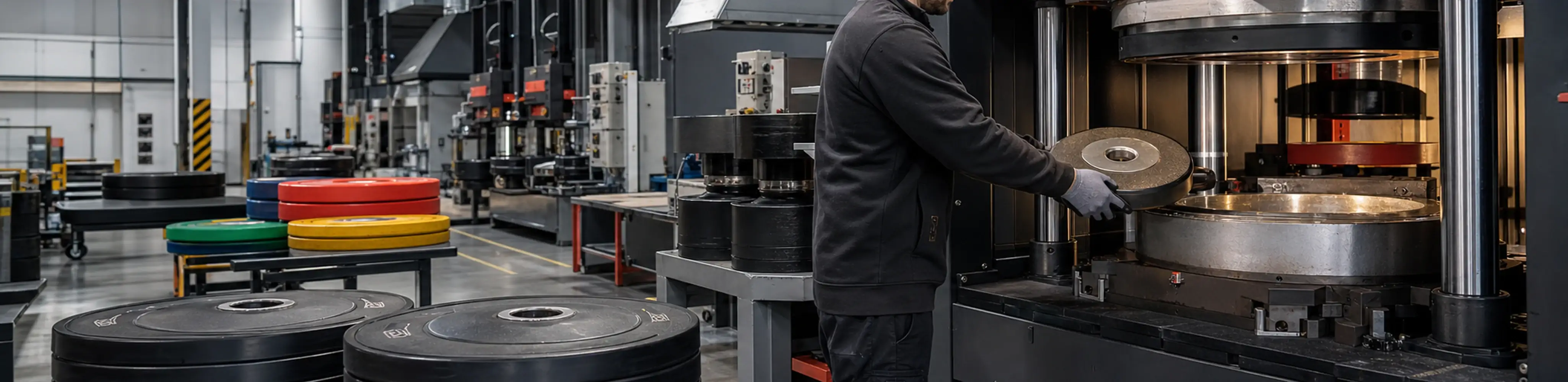
Ask which components are welded and whether the process is friction welding or another method. A covered joint may be invisible after moulding. A photograph of a neat external shoulder cannot verify weld integrity.
Interference or press-fit assemblies
The fit depends on the specified mating dimensions and assembly method. Press fitting can also be combined with welding or mechanical retention. Ask for the complete design; the force rating of a press is not a finished-dumbbell performance result.
Mechanically secured assemblies
Request the retention and locking arrangement, inspection method and service instructions. A mechanically secured design is not automatically inferior, and it is not automatically user-serviceable. Avoid a purchasing specification that accepts or rejects every design based solely on whether it has a bolt.

Evidence to request before approving production
| Buyer question | Useful evidence | What it does not prove |
|---|---|---|
| What retains the head? | Model drawing and assembly description | A generic catalogue photo is insufficient |
| Does it cover this weight? | Sample identity and configuration | A different size is not automatically equivalent |
| How was retention checked? | Method, fixtures, results and acceptance rule | A process name is not a test result |
| What changed after approval? | Revision and change record | Matching colour does not confirm matching construction |
| How is a fault handled? | Lot identification and remedy procedure | A warranty slogan does not define the process |
Separate three kinds of inspection evidence
Visual and dimensional checks
Check alignment, exposed damage, handle geometry and the accessible head-to-handle transitions. These checks can reveal visible nonconformities but cannot prove hidden joint integrity.
Joint retention testing
Ask a competent supplier or laboratory to define the fixture, loading direction, procedure, measurements and pass/fail criteria for the intended design. Axial separation and rotation are different behaviours; one test result does not answer every question. Do not invent a universal pull force or torque limit.
Repeated-use or impact validation
If impact evidence is offered, identify the weight, surface, orientation, repetitions and examination after testing. A short video without these conditions is not comparable evidence. Tested specimens must be controlled and must not be returned to sale as untouched stock.
Sample the construction changes within the range
One attractive light sample cannot validate an entire commercial dumbbell set. Ask whether head geometry, handle diameter, materials or joint construction change across the weight range. Select representative samples at those changes and agree how production lots will be sampled.
Keep routine batch acceptance separate from design validation. A report for a different weight, previous revision or different supplier component requires a documented explanation of applicability. Match sample identifiers, dated photographs and report references to the approved purchase specification.

Bulk inspection handover checklist
- Confirm model, weight marking, drawing revision and lot identity.
- Check visible alignment, surface damage and accessible junctions against the approved sample.
- Investigate unexpected rotation, rocking, gaps or noise using the agreed procedure.
- Review applicable test records and sampling coverage before release.
- Record rejected units and prevent their return to sale without an approved disposition.
OEM and custom branding need revision control
For OEM, ODM, Custom Logo and Private Label programmes, record which changes are cosmetic and which alter geometry, materials or assembly. A new end design, different head dimensions or changed handle can require another technical review. Approving artwork alone does not approve the structural assembly.
For Bulk Supply, compare quotations using the same model scope, weight mix, evidence package and packaging requirements. Ask the factory to quote samples, tooling, inspection and packing separately where applicable. MOQ and timing must be confirmed for the chosen configuration; no single value applies to every order.
Receiving, transport protection and fault records
Packaging should support the heavy heads and restrain movement without relying on the grip as the main support. The illustrated arrangement is a layout example; protection must be validated for the actual weight, carton and transport route. Record crushed cartons and product condition before discarding the packaging.
If unexpected head movement is found, segregate the affected units, identify the lot and notify the supplier. Preserve photos and purchase records. Do not improvise adhesive repairs, rewelding or tightening procedures. Agree who assesses the fault, whether related units require inspection, and how an approved replacement or remedy will be documented.
What to include in the factory enquiry
Send the intended commercial use, fixed-dumbbell style, weight range, units per weight, handle and head preferences, existing model reference, logo files and destination. Add a request for the construction description, applicable evidence, sampling proposal, acceptance criteria and after-sales handling. This gives the factory a concrete basis for review.
Technical references illustrating different documented constructions: REP hex dumbbells, Ivanko IUDB and Iron Grip dumbbells. Their model specifications do not establish the construction or performance of a PowerBaseFit product.
Products and related purchasing guidance
- Rubber hex dumbbells
- Commercial dumbbell range
- Pre-shipment inspection guide
- OEM sample approval
- Our factory
- Request a construction review
Frequently Asked Questions
Are welded dumbbells always better?
No. The complete design, materials, controlled assembly and applicable evidence matter. Different joint systems can be appropriate when properly specified and verified.
Can I judge the joint through its rubber covering?
You can assess the visible condition. You cannot establish hidden metal retention from the covering or a product photograph alone.
Does a drop video prove a whole order is acceptable?
No. Check the specimen, conditions and findings, then use the agreed batch acceptance plan. Design evidence and lot inspection serve different purposes.
Can a gym repair a loose fixed head?
Remove it from use and contact the supplier. Only follow an authorised, model-specific assessment and remedy; do not improvise a repair.
Should every weight use the same sample?
Ask where the construction changes. The sampling plan should cover relevant configurations rather than assume the smallest sample represents the range.
Does a logo change require new testing?
Not always. Review whether materials, geometry or assembly changed. Structural changes need an appropriate review before the revised product is released.
Discuss your dumbbell construction specification
Send your weight range, intended use and branding requirements. Our factory team can review the model, sample plan and evidence needed for your order. Request a factory review.