
Quick answer
Solid steel dumbbells are gaining attention because a dense metal head can deliver a compact profile, a distinctive premium appearance and a clear industrial identity. Those qualities suit clubs and brands that want their free-weight line to look different from standard rubber or urethane ranges. The choice is not automatically better for every facility: exposed metal needs suitable flooring, controlled handling, compatible storage and a realistic cleaning routine.
For a bulk OEM order, the useful question is not simply whether a supplier sells steel dumbbells. The buyer must define the construction, weight system, head geometry, handle dimensions, knurling, surface finish, end marking, logo method, packaging and inspection record for one identifiable version. A sample can confirm appearance and handling; production controls and batch inspection establish whether that approved version has been repeated.
What are solid steel dumbbells?
A solid steel dumbbell uses steel as the principal load-bearing material in the heads rather than relying on a cast-iron head hidden under a thick polymer coating. The exact assembly can differ by model. A head may be machined from steel stock, built from steel components or joined to a separate steel handle. The words solid steel should therefore lead to a bill-of-materials and construction question, not end the technical discussion.
Steel is not a synonym for every metal dumbbell. Cast iron and steel differ in composition and manufacturing behavior; stainless steel, carbon steel and plated or polished steel also describe different material-and-finish combinations. Chrome describes a surface treatment or visual finish, not by itself the material beneath it. A buyer should ask the supplier to identify the material for the head, handle, end plate and any concealed connection separately.
Rubber and urethane dumbbells usually place an elastomeric outer layer around an iron or steel core. That coating changes floor contact, noise, grip against a rack, odor, head dimensions, color and branding possibilities. An exposed steel design removes that thick outer layer and creates a more compact visual language, but transfers more responsibility to flooring, storage and surface protection.
Why are solid steel dumbbells becoming popular?
The first reason is visual positioning. Polished, brushed or dark-finished steel reflects light differently from molded rubber and gives a free-weight area a precise, architectural look. In a hotel, private club, boutique studio or flagship showroom, the equipment is part of the interior. A consistent steel set can support that design brief without needing oversized graphics or bright color coding.
The second reason is density. For the same nominal weight, steel allows a compact head relative to many coated constructions. The real size still depends on geometry, machining allowance, connection design and weight range, so buyers should compare dimension drawings rather than assume every steel model is smaller. Compact heads can improve spacing on a rack, feel less bulky during presses and make a complete range look orderly.
The third reason is product differentiation. Many distributors already sell familiar rubber hex or urethane round lines. A steel series with a distinctive head shape, end plate and finish can occupy a separate premium position. That advantage only lasts when branding is legible, the surface is repeatable and replacement pairs match the established range.
The fourth reason is maintenance visibility. Exposed metal does not hide scratches, moisture marks or careless rack contact. That sounds like a disadvantage, but it also lets a well-managed facility see and address problems early. Routine dry cleaning, removal of sweat, compatible surface care and prompt isolation of damaged pieces can preserve presentation. Steel is durable as a load-bearing material; its visible finish still needs operating discipline.
Member perception also matters. Dense, compact dumbbells can feel deliberate and professional when the handle, balance and rack layout are coherent. Perception is not a substitute for safety or specification. A premium appearance will not compensate for inconsistent knurling, sharp edges, unstable end components, inaccurate markings or poor floor planning.

Steel vs rubber vs urethane dumbbells
| Factor | Solid steel | Rubber-coated | Urethane-coated |
|---|---|---|---|
| Appearance | Exposed metal; precise industrial or premium look | Familiar commercial look; matte or molded surface | Clean premium molded surface with broad color options |
| Head size | Often compact for a given weight; confirm drawings | Coating and core can produce a larger head | Can be compact, but geometry and core still determine size |
| Floor contact | Requires suitable flooring and controlled handling | Coating adds a more forgiving contact surface | Coating adds surface protection; flooring is still required |
| Noise | More audible on hard contact | Generally quieter in routine handling | Generally quieter than exposed metal |
| Odor | No rubber odor; surface-care products still matter | New rubber can have a noticeable odor | Typically selected when low odor and premium presentation matter |
| Branding | End plates, engraving or marking depend on construction | Molded, printed or applied branding depends on model | Molded or colored branding can offer strong visual integration |
| Maintenance | Dry cleaning, sweat removal and corrosion-aware care | Check coating, odor, tears and bonding | Check cuts, surface marks and bond condition |
| Commercial fit | Premium controlled zones, clubs, hotels and differentiated ranges | General commercial gyms and functional areas | Premium high-traffic facilities and branded projects |
| Cost position | Driven by steel, machining, finish, geometry and branding | Common value-oriented commercial position | Often a premium coated position; compare full specification |
Where commercial steel dumbbells fit — and where they do not
Premium commercial gyms and private clubs may choose steel when the free-weight area is a design feature and staff can maintain the equipment. Bodybuilding and strength facilities may value a broad heavy range and compact heads, but should examine impact rules, flooring and how members return weights. A product intended to be dropped repeatedly should not be selected from appearance alone.
Hotel gyms and boutique studios often use a narrower range in a controlled environment. Here, visual quality, low visual bulk and an organized rack can be important. The project team still needs to consider humidity, cleaning chemicals and unsupervised use. Coastal or high-humidity locations require particular attention to material, surface treatment and care instructions.
Distributors and fitness brands evaluate a different risk: repeatability. They need SKU logic, kg or lb markings, packaging identifiers, end-cap artwork, replacement-pair policy and the ability to reorder a matching finish. A steel dumbbell can become a strong private-label product only when the technical record is as clear as the visual identity.
Rubber or urethane remains a more practical choice for many high-traffic zones where floor contact, noise reduction and forgiving handling take priority. A mixed specification can also be rational: steel in a premium controlled zone and coated dumbbells in functional or higher-impact areas. The facility brief should decide the material, not a universal ranking.
Production batch traceability and assembly control
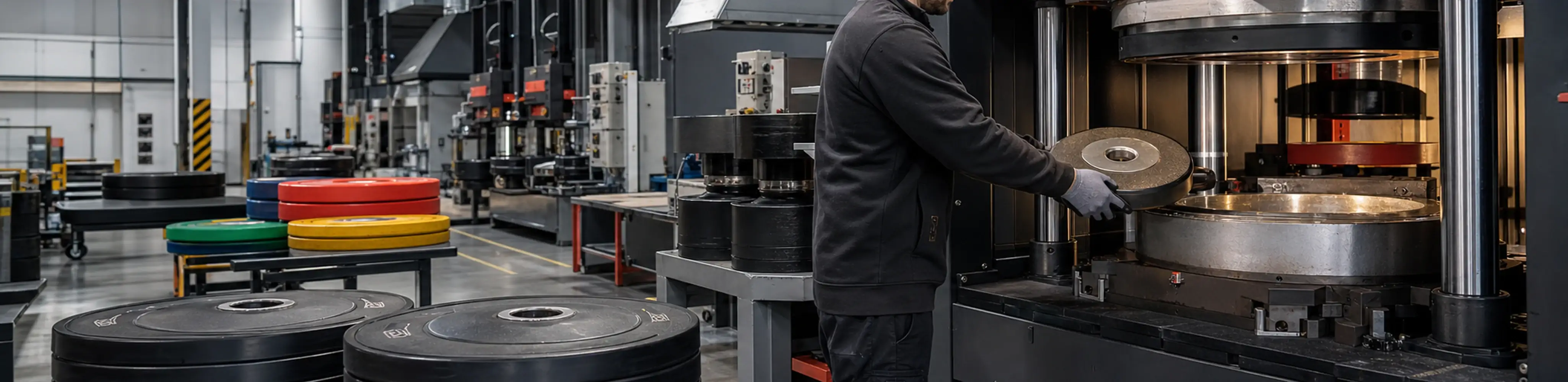
At the finished-batch stage, multiple steel dumbbells are checked under one SKU and weight system. End-plate orientation, weight marking, surface appearance and pair matching should follow the approved sample before packing.
During assembly, temporary identifiers keep head components, handle versions and nominal weights separated until the customer-facing end plates are fitted. The same identity should continue through final inspection and carton labeling.
For a bulk OEM order, retain a batch record containing SKU, weight unit, end-plate artwork revision, surface reference, quantity, inspection results and packing code. This record makes replacement pairs and repeat orders easier to match.

What can be specified in a bulk OEM steel dumbbell project?
PowerBaseFit's existing product information supports project-based planning for kg or lb systems, custom weight ranges and logo options on its 12-sided steel dumbbell, while its chrome dumbbell information supports discussion of colors, handle colors, logo plates and weight markings. Availability is model- and order-dependent. These options should be treated as items for feasibility confirmation, not as a promise that every method applies to every steel construction.
A useful OEM brief separates changes that affect only presentation from changes that affect tooling or construction. End-plate artwork, weight unit, carton label and protective packing may follow one approval route. Head geometry, handle design, diameter, knurl pattern, connection or a new weight increment may require a different sample and cost review. Combining all changes under the word custom makes quotations difficult to compare.
The artwork package should state logo file, end-plate diameter, clear area, orientation, color reference, weight marking and whether kg and lb are separate market versions. The technical package should state the range, increments, handle dimensions, finish reference, rack contact points and acceptance criteria. The logistics package should define units per carton, internal separation, carton marks, pallet plan and destination.
A private-label buyer should also agree how replacements will be handled. A pair supplied later needs to match the established head profile, handle feel, marking layout and surface as closely as the approved record requires. Keeping sample photographs, drawings, artwork versions and carton codes reduces ambiguity when a range is extended.
How a steel dumbbell order moves from specification to finished batch
The safest process begins with configuration control. The buyer and supplier identify the exact model, head and handle materials, nominal weights, geometry, finish, connection, end marking and packaging. A quotation that lists only steel dumbbell set leaves too many decisions open. Drawings and an approval list should use the same revision.
Material preparation and component machining depend on the selected construction. Record the actual process route for the quoted model, including the approved sequence for head and handle preparation, knurling, edge finishing and surface treatment.
During assembly, head-to-handle alignment and the specified connection matter because the dumbbell is repeatedly lifted, returned to a rack and exposed to off-axis contact. A buyer should request the connection drawing or approved description and agree how it is checked. The end plate or logo element is then installed according to the selected design, with orientation and fit reviewed against the sample.
Final control can include product identity, nominal weight, dimensions, handle diameter, grip consistency, finish, marking, assembly, quantity and packaging. The method, sampling level and acceptance decision must be written for the order, and every measurement needs an instrument, unit, result and criterion.
What should buyers check before ordering steel dumbbells in bulk?
- Weight tolerance — state the allowed deviation for each SKU, the weighing method and the response to an out-of-limit result.
- Handle diameter — check light and heavy samples because one diameter may not suit every user or every point in the range.
- Knurling consistency — define coverage, feel, alignment and acceptable sharpness; compare across more than one pair.
- Surface finish — approve color, gloss or brushing under agreed light and identify limits for scratches, pits, stains and edge marks.
- Corrosion resistance — match material, surface treatment, packaging and maintenance guidance to humidity, sweat and destination conditions.
- Head-to-handle connection — confirm the actual construction, alignment and inspection method instead of assuming it from the outside shape.
- Logo and marking durability — approve artwork, method, orientation and contrast on a production-representative sample.
- Packaging protection — prevent movement and metal contact, and review carton gross weight, labels and pallet plan.
- Rack compatibility — compare head width, handle clearance, saddle contact and total set length with the real storage system.
- Commercial-use behavior — define intended handling, flooring and no-drop or controlled-use rules where applicable.
- Sample approval — record what the sample proves, its version, measurements, photographs and any accepted deviation.
- Batch consistency — inspect multiple weights and cartons, then retain records that can be used for replacements and reorders.
Common mistakes when sourcing custom steel dumbbells
- Comparing unit price before confirming that material, finish, range, logo, packing and inspection scope are equivalent.
- Using steel, stainless steel, chrome and metal as interchangeable terms without a component-level material statement.
- Approving only a visual sample while weight, handle dimensions, knurling and connection remain undefined.
- Choosing a logo method from a rendering without checking fit, contrast, attachment and cleaning on a physical sample.
- Ignoring rack contact points and discovering after delivery that heads, handles or end plates do not sit correctly.
- Testing packaging with one convenient SKU instead of reviewing both heavy and small pieces, labels and pallet movement.
- Ordering without written tolerances, material statements and inspection criteria for the selected SKU.
- Failing to keep the approved revision, which makes replacement pairs and the next batch difficult to match.
Packaging, shipping and repeat-order control
Steel dumbbells concentrate substantial mass in a small volume, and polished surfaces can mark one another during movement. Packing should prevent metal-to-metal contact, restrict movement inside the carton and keep end faces away from fasteners or hard edges. The actual carton structure, protective material, gross weight and pallet pattern should be reviewed for the selected range and shipping route.
The heaviest SKU is not the only packaging test. Small pieces can shift more easily, mixed cartons create picking risk, and repeated weights need unambiguous labels. A packing sample should be reviewed with the finished product, while the packing list should reconcile SKU, weight unit, pair count, carton count and pallet identity.
For repeat orders, archive the approved sample record, finish reference, artwork, drawings, packing instruction and inspection results. Before changing a material, surface route, end plate, carton or component supplier, assess whether the change can affect appearance or function. Batch consistency is managed through version control, not through memory.
How to choose a steel dumbbell manufacturer
Choose a steel dumbbell manufacturer by comparing evidence for the exact proposed product. Ask whether the supplier can identify component materials, explain the assembly, supply model-specific drawings, prepare a representative sample, document the logo method, show packing protection and report inspection results. A broad factory claim is less useful than a clear answer tied to the quoted SKU.
Send every shortlisted supplier the same request: weights and increments, units per weight, kg or lb market, application, target finish, logo files, handle requirements, rack information, packaging, destination and inspection expectations. Compare the included scope before comparing unit prices. Tooling, artwork, samples, export packing, pallets and inspection can otherwise move between line items and make one quotation look lower without being equivalent.
The final purchase record should show what is approved, how it will be verified and who decides when a result is outside the agreed limit. This protects both buyer and manufacturer. It also creates the basis for a matching replacement pair or a later extension of the range.
Key takeaways for commercial buyers
Solid steel dumbbells are popular because compact proportions, dense construction and a controlled metal finish can give commercial spaces and private-label ranges a distinct premium identity. They are not a universal replacement for rubber or urethane. Flooring, noise, humidity, cleaning, handling and rack design remain part of the product decision.
For bulk OEM sourcing, define the version before requesting a final price. Approve material and construction, weight range, handle and knurling, surface, marking, logo, packaging and inspection as one connected record. Link each measurable requirement to a drawing, approved sample or inspection record so production and repeat orders follow the same version.
Related product and sourcing resources
- Compare commercial dumbbells
- View the 12-sided steel dumbbell
- Review chrome dumbbell options
- Read the commercial dumbbell guide
- Understand dumbbell weight checks
- See manufacturing and quality control
- Plan an OEM program
- Discuss a bulk requirement
Frequently Asked Questions
What are solid steel dumbbells?
They are fixed dumbbells whose heads use steel as the principal load-bearing material rather than a thick rubber or urethane outer body. The exact steel grade, head construction, handle and connection should be confirmed for the model.
Are steel dumbbells good for commercial gyms?
They can be a strong fit for premium, controlled free-weight areas with suitable flooring, storage and maintenance. Facilities that expect frequent hard drops or prioritize low noise may prefer a coated construction.
Are steel dumbbells better than rubber dumbbells?
Neither is universally better. Steel emphasizes compact proportions and metal presentation; rubber offers more forgiving floor contact and quieter handling. Choose according to the facility and operating plan.
What is the difference between steel and urethane dumbbells?
A solid steel model exposes a metal head, while a urethane model uses a polymer outer layer around a core. This changes appearance, floor contact, noise, color, maintenance and the available branding methods.
Do steel dumbbells rust?
Steel surfaces can corrode when material, finish, humidity, sweat, cleaning and storage are not managed together. Confirm the surface system for the model and follow the approved care instructions.
How do you maintain commercial steel dumbbells?
Remove sweat promptly, use a compatible cleaner, dry the surface, inspect contact points and keep the rack and flooring clean. Isolate a piece if the connection, edge, handle or end component appears damaged.
Can steel dumbbells be customized with a gym logo?
Logo and end-plate options can be reviewed for compatible models. The method, artwork, size, position, attachment, quantity and sample must be confirmed before production.
Can I order OEM steel dumbbells in bulk?
Yes, subject to the selected model and project feasibility. Send the weight range, quantities per weight, kg or lb system, logo files, finish, packaging, destination and rack information for review.
How do I choose a steel dumbbell manufacturer?
Compare model-specific evidence: materials, drawings, sample, connection description, finish control, weight checks, artwork approval, packaging and inspection reporting. Do not rely on a general factory claim alone.
What should distributors check before importing steel dumbbells?
Check the SKU range, markings, local units, carton and pallet data, replacement policy, surface protection, inspection criteria and the applicable import requirements for the destination market.
Are steel dumbbells suitable for high-traffic gyms?
They can be when construction, floor, rack, user rules and maintenance suit the traffic level. High traffic does not remove the need to control hard impacts and surface contact.
How should commercial steel dumbbells be packaged for international shipping?
The pack should separate finished metal surfaces, prevent movement, identify every SKU and remain manageable at carton and pallet level. The final method should be tested and approved for the ordered range.
Discuss your custom steel dumbbell project
Send the weight range, quantities, logo files, destination and rack information for a model-specific bulk review. Request an OEM dumbbell quote.