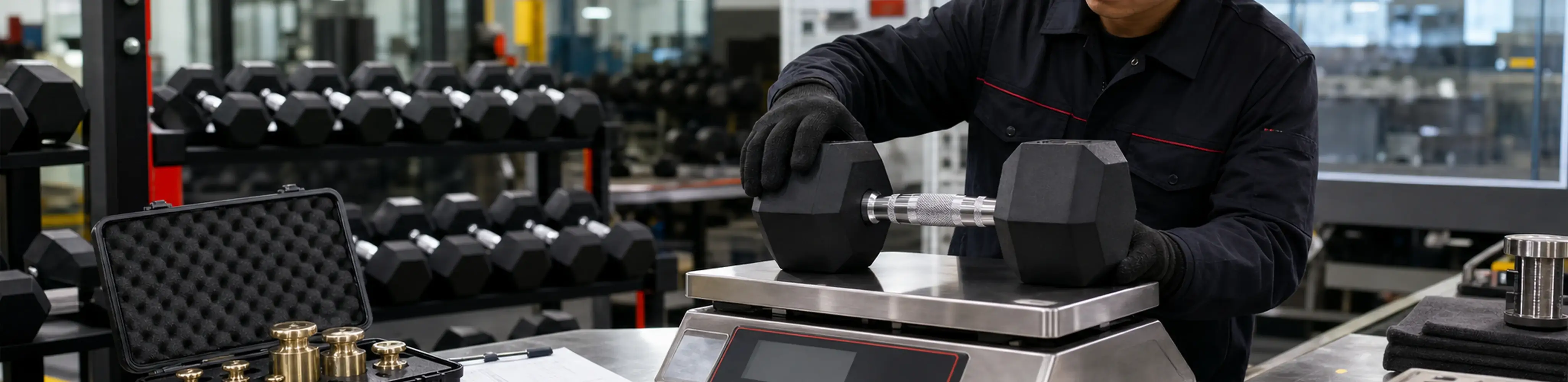
Dumbbells are weighed on verified industrial scales after the major components are assembled and again at the finished-product inspection stage when required. The operator confirms that the scale is suitable for the dumbbell range, checks it with traceable or controlled reference weights, zeros the platform, places the clean dumbbell centrally, waits for a stable reading, and records the result. The measured value is compared with the nominal weight and the tolerance agreed in the product specification.
Good weight control involves more than placing one sample on a digital scale. The factory must manage the scale's capacity, readability, calibration status, environment, sampling plan, unit conversion, and response to out-of-tolerance pieces. Product construction also matters: a cast iron head, machined steel dumbbell, rubber-coated core, and selectorized adjustable system reach target weight in different ways. This guide is for gym owners, importers, distributors, fitness brands, and quality teams who want to understand what a credible weight-accuracy claim looks like before approving a dumbbell order.
Quick Answer: How Are Dumbbells Weighed?
Question: How are dumbbells weighed?
Answer: A manufacturer weighs dumbbells on an industrial bench or platform scale that is appropriate for the product's mass and verified with reference weights. The dumbbell is placed centrally, the stable reading is recorded, and the deviation from nominal weight is calculated. The result must fall within the written tolerance for that model. Reliable factories also control scale checks, sampling frequency, unit conversion, nonconforming pieces, and inspection records rather than relying on a single demonstration measurement.
What Does the Weight Printed on a Dumbbell Mean?
The marking is the nominal mass of one dumbbell unless the product or catalogue clearly states otherwise. A “10 kg” fixed dumbbell is intended to represent one 10 kg implement, not a 10 kg pair. Retail packages sometimes display the combined weight of two pieces, so catalogues and cartons must make the basis explicit.
Nominal weight is a target, not a claim that every molecular component sums to exactly 10.000000 kg. Manufacturing processes naturally vary, which is why a specification defines an acceptable tolerance. The measured actual weight should remain inside that range.
Does a 20 kg dumbbell weigh exactly 20 kg?
It should be close to 20 kg and within the declared tolerance, but it may not be mathematically exact. Castings, rubber molding, plating, adhesive, machining, and assembly all introduce small variation. A premium or calibrated product can target tighter control than a general fitness dumbbell. The buyer should ask for the numerical tolerance and inspection method rather than assuming that all products with the same label have identical accuracy.
Is dumbbell weight per hand or per pair?
Commercial fixed dumbbells are normally marked per piece. Two 10 kg dumbbells provide 20 kg of total external mass when used together. Some consumer sets advertise combined package weight, which can cause confusion. An RFQ should state “quantity per piece,” “pairs per weight,” and the total number of dumbbells. Cartons should also identify piece count, nominal unit weight, net weight, and gross weight separately.
What Equipment Is Used to Weigh Dumbbells?
Factories commonly use bench scales for light and medium dumbbells and low-profile platform scales for heavier products or packages. The selected scale needs enough capacity for the heaviest item, suitable readability for the tolerance being checked, and a platform that supports the product safely.
Technical information: A scale with very high capacity but coarse increments may be unable to resolve small deviations on light dumbbells. A very sensitive laboratory balance may be impractical or unsafe for large commercial weights. Measurement equipment must fit the job.
| Equipment | Purpose | Key control |
|---|---|---|
| Bench scale | Individual light-to-medium dumbbells | Capacity, readability, level platform |
| Platform scale | Heavy dumbbells, sets, or cartons | Stable floor, central loading, suitable range |
| Reference weights | Verify scale response | Identification, protection, check schedule |
| Check fixture or cradle | Stabilize round products when necessary | Must not add unaccounted mass or side load |
| Inspection record | Link result to batch and product | Model, nominal weight, actual weight, date, operator |
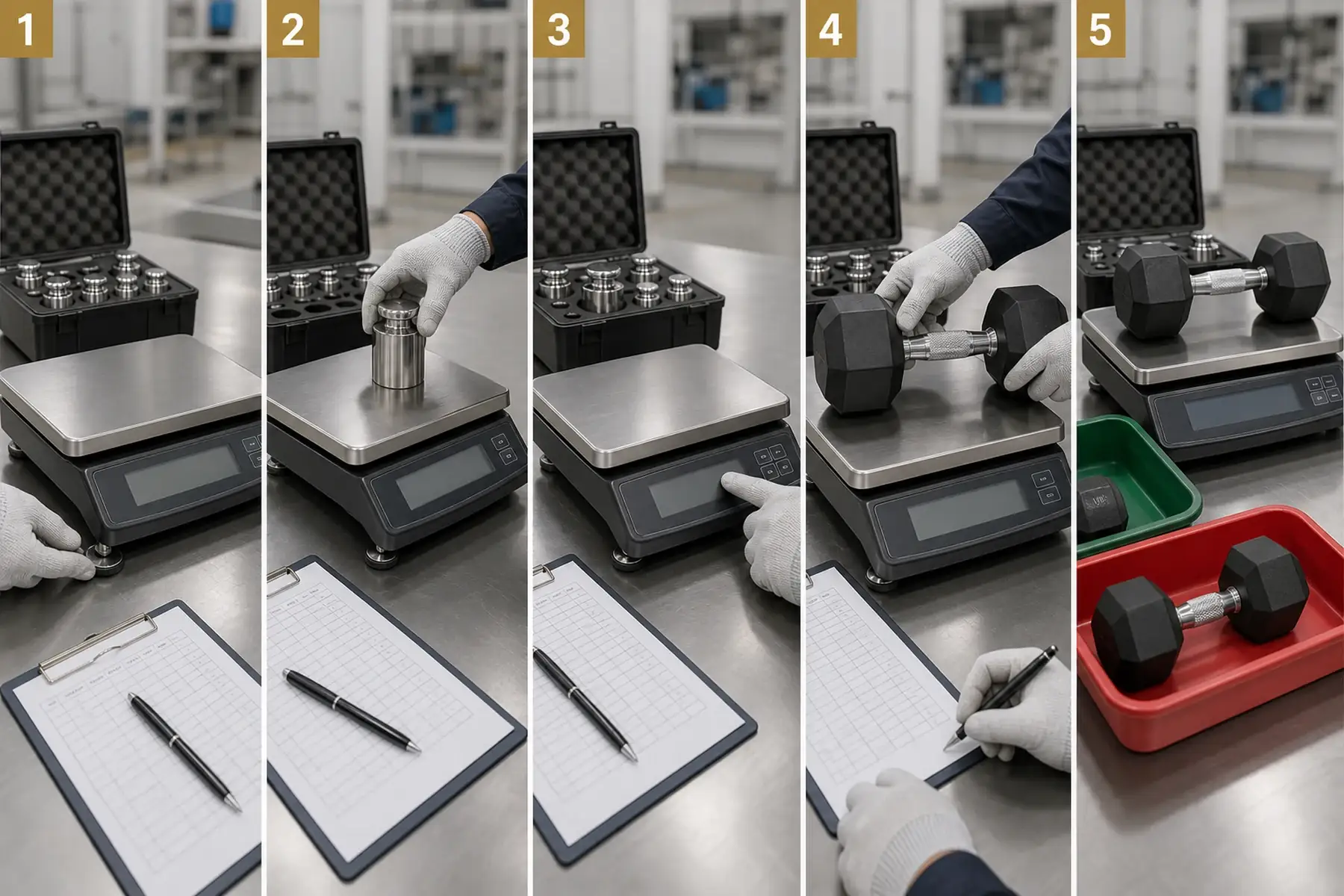
How Is a Scale Verified Before Production Weighing?
The operator checks the scale's identification and status, confirms it is level and clean, powers it according to procedure, and verifies zero. Suitable reference weights are then placed on the platform at points relevant to the working range. The observed readings must meet the facility's acceptance criteria before product inspection continues.
Formal calibration and routine verification are related but different. Calibration establishes the relationship between indicated and reference values under stated conditions. Routine checks confirm that the scale remains fit for daily use between calibrations. Adjustment changes the scale response; it should not be confused with calibration evidence.
What are calibration weights?
Calibration or reference weights are physical mass standards with known values and controlled accuracy. Factories use them to check whether a scale reads correctly at relevant points. They should be identified, protected from corrosion and damage, handled properly, and reviewed on a defined schedule. Using an unverified gym plate as the only “standard” merely compares one unknown item with another.
What Is the Step-by-Step Dumbbell Weighing Process?
The exact work instruction varies, but a controlled finished-product check follows a repeatable sequence.
- Identify the product. Confirm model, unit system, nominal weight, batch, and tolerance.
- Inspect the scale. Check status label, capacity, readability, cleanliness, level, and power.
- Verify performance. Use appropriate reference weights and record the check where required.
- Zero or tare. Ensure the display returns to zero; tare an approved cradle if one is used.
- Place the dumbbell centrally. Avoid impact, rolling, side contact, or leaning on nearby surfaces.
- Wait for stability. Read only after the display settles.
- Record the actual value. Do not round more favorably than the procedure permits.
- Calculate deviation. Compare actual with nominal as mass and, when required, percentage.
- Accept, segregate, or rework. Follow the approved control plan.
- Review the batch. Escalate trends even if individual units are still barely within tolerance.
How is dumbbell weight deviation calculated?
Absolute deviation equals actual weight minus nominal weight. Percentage deviation equals that difference divided by nominal weight, multiplied by 100. For example, if a nominal 10 kg dumbbell measures 9.9 kg, the deviation is -0.1 kg, or -1%. Whether that passes depends on the written specification. Buyers should state whether the tolerance is symmetric or whether underweight and overweight limits differ.
Should dumbbells be weighed before or after coating?
Both stages can be useful. Core or subassembly weighing helps production correct mass before the outer process. Finished weighing confirms what the customer receives after rubber, polymer, paint, plating, markings, and final assembly are present. The final acceptance decision should use the product state defined in the specification. If only cores are checked, coating variation and assembly errors may go undetected.
How do manufacturers control weight during production?
Weight control starts before final inspection. The factory designs the core or casting to leave an allowance for coating and finishing. Raw material or metal components are measured, molds are filled with controlled preform weights, machining removes predictable material, and assemblies are checked at defined points.
Manufacturing facts by product type:
- Cast iron dumbbells: mold fill, casting variation, fettling, and coating affect final mass.
- Machined steel dumbbells: stock dimensions and machining can provide tighter repeatability, but plating and assembly still matter.
- Rubber hex dumbbells: metal core mass, handle, rubber preform, molding flash, and trimming contribute.
- Round PU/CPU/TPU dumbbells: core design and casting or molding quantity must account for the outer body.
- Adjustable dumbbells: each plate or module, handle, and selector combination must produce the intended settings.
How can an overweight dumbbell be corrected?
Correction depends on design and process stage. A metal core may be machined or ground at an approved correction location before coating. Some assembled precision products use controlled internal adjustment features. Removing material randomly from a finished structural area can damage balance, appearance, corrosion protection, or strength. Any rework method should be engineered, documented, and reinspected.
What Weight Tolerance Should Dumbbells Have?
There is no single global tolerance for every fitness dumbbell. The acceptable limit depends on product grade, weight, manufacturing route, market promise, and buyer agreement. A practical specification states the allowed deviation for each nominal weight or weight band, the measurement method, and the inspection plan.
Tighter tolerance generally requires better core control, more measurement, possible rework, and a lower acceptable yield. It can increase cost. Buyers should select accuracy that supports the training and commercial purpose rather than copying a competition-plate tolerance onto every studio dumbbell without considering value.
| Product context | Accuracy priority | Practical buyer approach |
|---|---|---|
| Light studio dumbbells | Small absolute differences are noticeable | Specify fine scale readability and clear markings |
| General commercial set | Consistency across pairs and progression | Define percentage/absolute limit and pair matching |
| Heavy strength dumbbells | Large total mass and safe handling | Use suitable platform scale and control handle/core assembly |
| Premium machined set | Brand promise and visual precision | Request tighter written tolerance and full records |
| Adjustable system | Accuracy at each selected setting | Test modules and representative combinations |
Is a 2% dumbbell weight difference acceptable?
It may be acceptable for some general fitness products and unacceptable for another buyer's premium specification. The answer must come from the purchase agreement, not a universal rule. Also consider absolute difference: 2% of 2 kg is 0.04 kg, while 2% of 50 kg is 1 kg. A specification can combine percentage and maximum absolute limits to control both ends of a range.
Should a pair of dumbbells match each other exactly?
They should both meet the nominal tolerance, and many buyers also request reasonable pair matching so bilateral exercises feel consistent. Pair matching can be controlled during packing by grouping actual weights or by tighter process limits. It adds handling and record complexity. State the requirement before quotation; do not assume standard warehouse picking creates specially matched pairs.
Why can rubber-coated dumbbells vary in weight?
A rubber-coated dumbbell combines several sources of variation: metal core, handle, rubber compound preform, mold fill, flash, trimming, and any printed or molded components. Rubber density and flow also respond to formulation and process conditions. The manufacturer therefore targets the core and preform so the finished assembly lands inside the final tolerance.
Cosmetic rework can change mass slightly, but a large discrepancy usually indicates a core or material-control problem. A thick outer coating should not be treated as an unlimited correction layer.
Can dumbbell weight change over time?
Under normal indoor use, a fixed dumbbell should not change enough to affect training meaningfully. Severe chipping, missing end caps, loose components, corrosion, or damaged selector parts can reduce or redistribute mass and make the product unsafe. Rubber aging may change surface condition but not normally kilograms of mass. Remove damaged equipment from service and inspect the connection and marking before debating a small scale difference.
How are adjustable dumbbells weighed?
Adjustable dumbbells require a system-level plan. The manufacturer weighs individual plates or modules, handles and mechanisms, then verifies representative or all selected settings depending on the control plan. Tolerance stack-up matters: small errors in several plates can combine at the heaviest setting.
The displayed setting should correspond to the actual total lifted mass according to the product definition. Some systems include the handle in the labeled weight; others describe plates separately. Documentation and marketing must use the same convention.
Are selectorized dumbbells accurate at every setting?
They should meet the stated specification at every setting, but the deviation may vary as modules accumulate. A sound validation plan tests the light, middle, and maximum settings and reviews both sides of a pair. It also checks that the selector captures the correct plates, the display aligns with the mechanism, and no plate remains partially engaged. Accuracy without reliable locking would not make the product safe.
How Should Importers Audit Dumbbell Weight Accuracy?
Importers should convert “accurate weight” into an inspection instruction. State the product list, nominal values, tolerance, sampling level or full-inspection requirement, scale capability, reference check, rounding rule, pair-matching requirement, and response to failures.
Pre-shipment audit checklist:
- Confirm approved product and packaging samples.
- Review the scale ID and current calibration/verification status.
- Observe a reference-weight check near relevant working loads.
- Select samples across models, weights, cartons, and production times.
- Record actual values rather than pass/fail only.
- Check labeling, units, and carton mix against the packing list.
- Investigate a trend toward one tolerance limit.
- Define expanded sampling or containment when a failure occurs.
Is random sampling enough for dumbbell weight inspection?
Sampling can provide reasonable assurance for a stable, controlled process, but it cannot guarantee every piece. Full weighing may be justified for premium products, new suppliers, unstable processes, or critical customer requirements. The right plan balances risk, order size, process capability, and inspection cost. If a sample fails, the response should be predetermined—expanded sampling, sorting, rework, or rejection—not negotiated after shipment pressure begins.
How Does PowerBaseFit Check Dumbbell Quality?
PowerBaseFit's free weight quality discussions can include material and component checks, handle alignment, surface finish, weight verification, markings, carton labels, and packing condition. The exact inspection plan is agreed according to product type and buyer requirement. We do not treat one scale photo as proof of the entire shipment; the product specification, process control, sampling, records, and final packing review work together.
Buyers can compare the full dumbbell range, rubber hex dumbbells, machined steel dumbbells, chrome dumbbells, and TPU round dumbbells. The factory page and OEM factory evaluation guide help build a broader supplier checklist.
What information should buyers include in a dumbbell RFQ?
State fixed or adjustable design, head material and shape, handle construction, KG or LB range, quantity per size, tolerance, pair-matching requirement, logo, markings, rack compatibility, packaging, inspection evidence, destination, and timeline. If a third-party inspection company will be used, share the checklist before production. Clear requirements let the manufacturer design the correct core and quality plan before the mold or batch is committed.
Frequently Asked Questions About Dumbbell Weight Accuracy
Why does my 10 lb dumbbell not equal 4.54 kg exactly?
Ten pounds converts to approximately 4.5359 kg, but a scale may round the display and the dumbbell itself has manufacturing tolerance. A product marked in pounds is manufactured to the pound nominal value, not necessarily to a neatly rounded kilogram label. Dual-marked products should use a clear conversion convention. Do not relabel a 10 lb dumbbell as 5 kg; those nominal values differ by more than normal rounding.
Are cheap dumbbells less accurate?
Price alone does not prove accuracy. Lower-cost manufacturing may allow wider tolerances or less inspection, but an inexpensive, well-controlled casting can still meet its declared specification. A premium price can reflect material, finish, branding, distribution, or warranty rather than tighter mass control. Ask for the numerical tolerance and verify samples. Measurable requirements are more reliable than price-based assumptions.
Can I check dumbbell accuracy at home?
You can perform a basic comparison with a stable scale and a known reference item, but household equipment may not support a commercial claim. Place the scale on a hard level surface, verify zero, use the same central position, and repeat readings. Avoid holding the dumbbell while standing on a bathroom scale; subtracting two body-weight readings introduces larger uncertainty. For a dispute, use a competent inspection or metrology service.
Why are two identical dumbbells slightly different in size?
Molded or cast products can show small dimensional variation from tool cavity, finishing, material flow, shrinkage, and coating thickness. If both meet weight and dimensional specifications, a minor difference may be cosmetic. Significant asymmetry can affect rack fit, balance, or pair presentation and should be checked. Premium matched sets typically use tighter cosmetic and dimensional controls.
Is gross carton weight useful for checking dumbbells?
It is useful as a logistics and gross-error check but cannot replace individual product weighing. Carton, inserts, plastic, labels, moisture, and piece count all contribute to gross weight. A carton reading may reveal a missing dumbbell or incorrect mix, yet several overweight and underweight pieces could cancel each other. Use both product and packaging controls for export orders.
Do heavier dumbbells require a different scale?
Often, yes. The scale must safely support the load and platform footprint while retaining enough readability for the tolerance. A 100 kg capacity platform may be appropriate for very heavy units, while light studio dumbbells need finer resolution. Factories may maintain multiple scales for different ranges. The inspection record should identify which scale was used.
What happens if a shipment fails weight inspection?
The affected pieces or lot should be segregated, the scale and method rechecked, and the production cause investigated. The agreed inspection plan determines expanded sampling, sorting, rework, replacement, or rejection. Shipping first and resolving later increases cost for everyone. Buyers and suppliers should define acceptance and corrective action before mass production.
Does weight accuracy affect workout results?
Small within-tolerance differences are unlikely to transform muscle or strength outcomes, but large or inconsistent errors can disrupt progression, bilateral balance, member trust, and commercial claims. Accurate labeling is also part of a professional gym experience. The greatest risk is not a tiny deviation; it is an uncontrolled product whose actual mass and pair consistency are unknown.
Measurement References and Next Steps
The measurement principles in this article align with metrology practices described by the U.S. National Institute of Standards and Technology for weighing devices and standards. They are applied here as factory quality guidance rather than a claim that general fitness dumbbells are regulated trade weights.
For an OEM or commercial set, send PowerBaseFit the models, weight range, quantities, target tolerance, pair matching, logo, packaging, inspection method, and destination. We can review the manufacturing route and prepare a quotation with defined quality checkpoints.
Request Dumbbell Specifications and a Quote