
Introduction
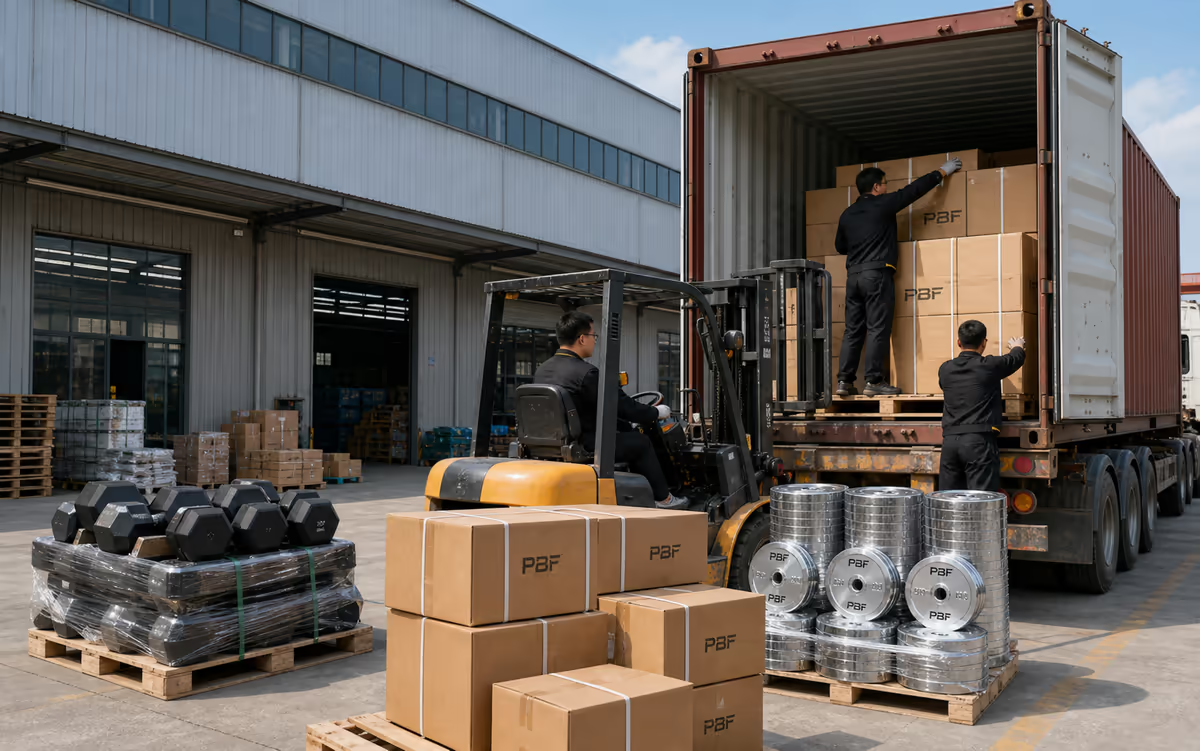
The factory price of a dumbbell or weight plate is not its final cost in the buyer's warehouse. Free weights are dense, require strong packaging, and can create destination handling costs that do not appear on a product quotation. A distributor who compares only unit prices may select an offer that becomes less competitive after packing, freight, clearance, and inland delivery are included.
A landed-cost model brings these elements into one controlled calculation. It does not predict future freight rates or replace a customs professional. It shows which inputs are confirmed, which are estimates, and how changes in product mix or trade terms affect the decision. This is valuable for importers setting resale prices, gym owners comparing direct sourcing with local supply, and brands planning inventory investment.
Quick Answer
Calculate landed cost by adding the product value, customization, tooling allocated to the order, export packaging, origin charges not included in the factory term, international freight, insurance, customs duties and taxes where applicable, brokerage, examination or port charges, inland delivery, and receiving costs. Divide the total by a meaningful allocation base such as units, pairs, net kilograms, cartons, or product value.
Use current written quotes for logistics and destination charges. Record the Incoterm and the date of every estimate. Do not apply one freight percentage to every free weight product: dense plates, bulky racks, mixed containers, and retail-packaged items use shipment capacity differently.
Definition: What Is Landed Cost?
Landed cost is the total cost required to bring purchased goods from the agreed supplier point to a defined destination in saleable or usable condition. The destination might be a port, distribution center, gym site, or buyer warehouse. The definition must state where the calculation stops.
For a free weight order, landed cost can include costs incurred before shipment, during international transport, at customs, and after release. It may also include internal receiving or quality costs if the buyer uses landed cost for inventory valuation or project budgeting. Accounting treatment varies, so the commercial model should be aligned with the buyer's finance team.
Fix the Scope and Incoterm First
Start with the supplier's quoted trade term. EXW, FOB, CIF, and other Incoterms allocate defined tasks, costs, and risks between seller and buyer, but a three-letter term alone is incomplete. Record the named place or port and the applicable Incoterms version in the contract. Ask what the supplier's price specifically includes.
For example, an FOB quote normally includes different origin activities from an EXW quote, but local practices and excluded services still need written clarification. A CIF quote includes named cost elements to the destination port but does not automatically mean the goods are cleared, duty paid, or delivered to the warehouse. Buyers should confirm responsibilities with their forwarder and contract adviser.
Do not compare an EXW offer with a FOB offer as if the product price were the only difference. Add the origin pickup, export handling, documentation, and terminal costs needed to place both offers at the same comparison point.
Build the Product-Cost Layer
The product layer begins with quantities and agreed unit prices. Separate each dumbbell weight, plate weight, rack, accessory, and spare component. Add custom logo charges, color premiums, mold or tooling costs, samples credited or not credited, retail packaging, barcodes, and any order-specific testing.
Decide how one-time costs will be allocated. A logo mold may support several production orders, while a sample freight charge belongs to project development. For a conservative first-order model, the buyer may expense all setup costs into the initial shipment. For ongoing inventory planning, finance may amortize approved tooling across expected units. Document the method so margin comparisons remain consistent.
Check whether quotations use pieces, pairs, sets, or kilograms. A unit mismatch can distort the model more than a small price change. Reconcile the purchase schedule before adding logistics.
Collect Packaging and Shipment Data
Ask the supplier for net weight, gross weight, carton dimensions, units per carton, pallet count, pallet dimensions, and estimated cubic volume. For mixed equipment, request a provisional loading plan. Free weights may reach weight limits before a container is physically full, while racks and benches consume more volume relative to weight.
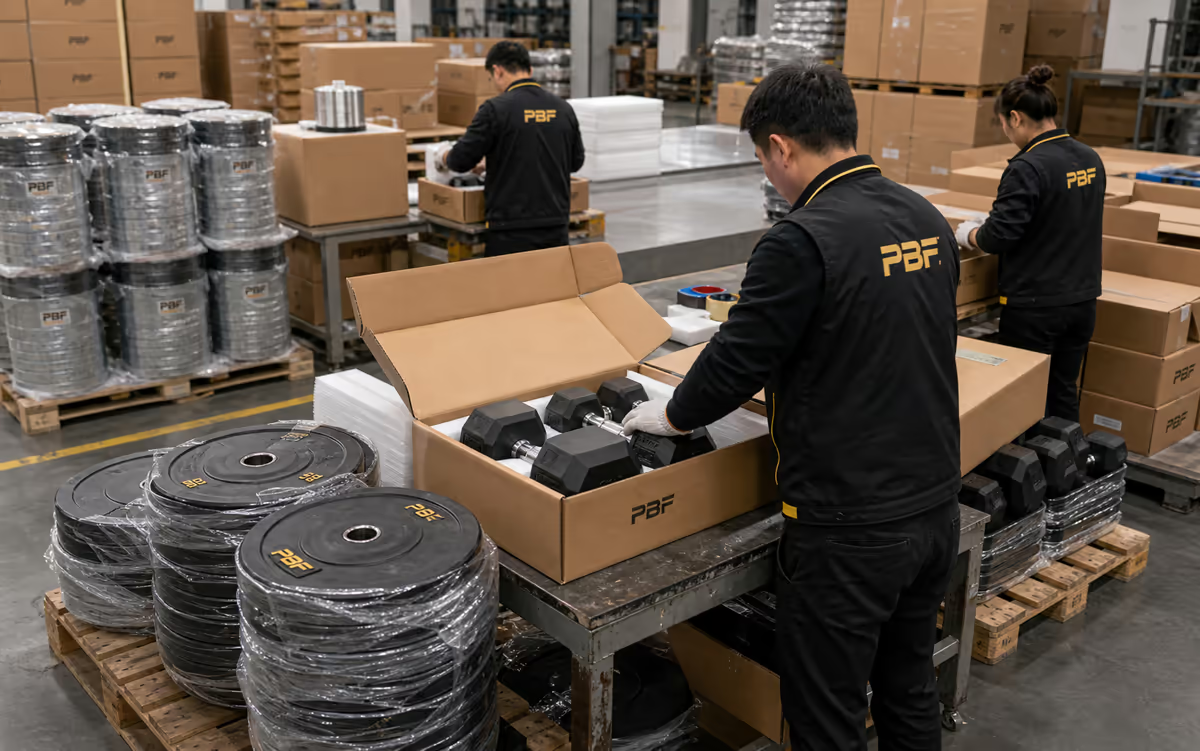
Packaging choices influence both damage risk and cost. Individual cartons, reinforced board, separators, foam, corner protection, pallets, retail boxes, and branded labels add material and sometimes volume. Removing protection to reduce freight can create higher claims, rework, or unsaleable inventory. Compare packaging as part of the product specification.
The final packing list is produced after packing, but the pre-order estimate should be detailed enough for a forwarder to quote. Mark all figures as estimated until the factory confirms the production packing data.

Map Every Cost Stage
| Cost stage | Typical inputs | Source of confirmation |
|---|---|---|
| Product | Units, customization, tooling, packing | Manufacturer quotation |
| Origin | Pickup, export handling, documents, terminal | Supplier and forwarder |
| Main transport | Ocean, rail, air, or multimodal freight | Current forwarder quote |
| Risk protection | Cargo insurance and required coverage | Insurer or forwarder |
| Border | Duty, tax, brokerage, inspection | Customs broker and authorities |
| Destination | Port, terminal, storage, demurrage risk | Carrier, terminal, broker |
| Final delivery | Drayage, liftgate, unloading, appointment | Local transport provider |
| Receiving | Count, inspection, relabeling, put-away | Buyer operations |
Not every order incurs every line. The purpose of the map is to prevent a missing category, not to invent charges. Use zero only when the scope confirms that a cost does not apply; otherwise mark it pending.
Account for Duties, Taxes, and Customs Value Carefully
Tariff classification, country of origin, customs value, trade remedies, and local rules influence border costs. Product descriptions such as “fitness equipment” may be too broad for classification. Different components or products in one shipment may use different codes. The importer of record remains responsible for accurate declarations.
Do not copy a duty rate from an old article or another country. Ask a qualified customs broker to classify the actual products and confirm current rates, taxes, documentation, labeling, and any product requirements. Provide materials, function, construction, and commercial invoices to support that review.
When evaluating scenarios, keep the rate input separate from the product data. If regulations or rates change, the buyer can update one field without rebuilding the entire cost model.
Allocate Freight Across Heavy and Bulky Products
Dividing freight only by unit count is rarely fair. A heavy bumper plate and a small accessory should not receive the same freight allocation. Possible bases include net weight, gross weight, cubic volume, product value, or a hybrid rule.
For a shipment dominated by free weights and constrained by mass, gross weight can be a practical starting point. For a mixed container containing racks, benches, cartons, and plates, use chargeable space or a hybrid of weight and volume. High-value but compact products may also require value-based insurance allocation.
Choose the method that supports the business decision. A distributor needs SKU-level inventory cost. A gym project may only need category or zone cost. Keep the total shipment cost unchanged and document how it is distributed.
Model Full-Container, Consolidated, and Phased Options
A full container can offer control over loading and reduce handling between shipments, but only when the order justifies the capacity and inventory. Less-than-container or consolidated freight can support a smaller launch but adds handling points and different minimum charges. Air freight is generally unsuitable for routine heavy free weights, though it may serve samples or urgent small components.
Create at least two scenarios: planned order and reduced or phased order. Recalculate product value, packing, origin minimums, freight, destination minimums, and inventory holding. A smaller shipment does not reduce every charge in proportion to units.
Do not increase quantities only to improve freight per unit without checking demand and cash flow. Lower allocated freight can be offset by slow inventory, storage, discounting, or model changes.
Include Risk and Variance
Quotes expire, exchange rates move, and containers can incur inspection, storage, or delay costs. A landed-cost model should show a base case and a controlled contingency rather than hide uncertainty. The percentage or amount should follow the buyer's risk policy and current evidence; it should not be presented as an industry rule.
Track quote dates, currency, validity, free-time assumptions, and excluded charges. Run sensitivity tests for freight, exchange rate, duty classification, and product quantity. This shows which variable can materially change margin.
Damage and shortage also affect the commercial outcome. Define packaging, loading evidence, insurance, receiving inspection, and claim procedures before shipment. Prevention is usually easier than allocating an unplanned loss after arrival.
Buyer Checklist
- Define the exact endpoint of the landed-cost calculation.
- Normalize supplier offers to the same Incoterm and named place.
- Reconcile pieces, pairs, sets, and quantities by weight.
- Include customization, samples, tooling, and special packaging.
- Obtain net weight, gross weight, cartons, pallets, and volume.
- Request a current forwarder quote based on the estimated shipment.
- Confirm classification and current border costs with a broker.
- Select a documented allocation rule for weight and volume.
- Include destination delivery, unloading, and receiving activities.
- Record currency, quote date, validity, assumptions, and exclusions.
- Test planned, phased, and changed-freight scenarios.
- Update the model with final packing and actual invoices after arrival.
Factory Information That Improves the Model
The manufacturer should provide a detailed product schedule, quotation scope, estimated packing information, origin location, proposed port, production timing, and loading assumptions. For dense orders, the factory can help explain how plate and dumbbell cartons are distributed and how racks or other equipment are protected.
PowerBaseFit can confirm model-dependent weights, packaging, customization, and estimated loading after the buyer supplies a product list and destination. Freight, duties, taxes, and destination services should still be confirmed by the responsible service providers. This separation prevents a factory estimate from being mistaken for a guaranteed customs or delivery cost.
After production, update the model with the final commercial invoice and packing list. After delivery, compare estimates with actual charges. That variance review improves the next order.
Conclusion
Landed cost is a decision system, not a single percentage added to the factory price. For wholesale dumbbells and weight plates, it must reflect dense cargo, packing, shipment structure, customs, and destination operations. A transparent model shows both confirmed inputs and open risks.
Prepare the product schedule, quantities, packaging expectations, destination, and preferred trade term. Request a PowerBaseFit quotation for the manufacturing and packing inputs, then combine it with current forwarder and customs advice to build a defensible landed-cost calculation.
Frequently Asked Questions
Why is freight per dumbbell not the same for every order?
Order mix, packing, route, shipment mode, minimum charges, weight limits, volume, and current market rates change the allocation. Use shipment-specific data rather than a fixed freight amount per piece.
Should tooling be included in landed cost?
It should be included in the project economics. Whether finance allocates it entirely to the first order or across expected production depends on the buyer's accounting policy and confidence in future volume.
Is CIF the same as delivered duty paid?
No. CIF covers defined cost, insurance, and freight obligations to the named destination port under the agreed rules. It does not automatically include import clearance, duties, taxes, or warehouse delivery.
What is the best freight allocation method for free weights?
There is no universal method. Gross weight often helps with weight-constrained free weight shipments. Mixed containers may require weight-and-volume allocation. Use a method that reflects the constraint and document it.
When should the landed-cost model be updated?
Update it when the product list, packing estimate, Incoterm, freight quote, exchange rate, classification, or destination costs change. Reconcile again with final documents and actual invoices after delivery.